
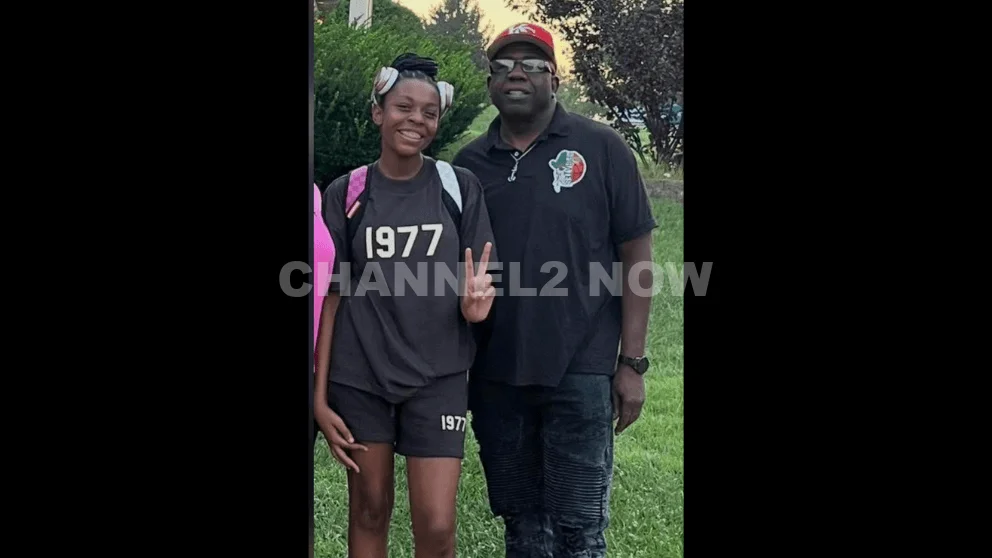
FERGUSON, Mo. — The quiet, residential streets of North St. Louis County were the site of an incomprehensible tragedy this weekend, plunging multiple communities into a state of profound, collective grief. A sudden, catastrophic act of gun violence inside a Ferguson residence has claimed the lives of a deeply respected public servant and a vibrant high school student, leaving a region struggling to process the sheer magnitude of the loss.
Retired Berkeley Fire Chief Henry Williams and his 15-year-old daughter, Halayna Williams, were fatally shot on Saturday evening. The devastating incident has sent shockwaves through local fire departments, school districts, and neighborhoods across the St. Louis metropolitan area.
In a rapid development following the discovery of the victims, the Ferguson Police Department and local prosecutors announced that 61-year-old Linda Hayden has been officially arrested and charged with two counts of First-Degree Murder and Armed Criminal Action in connection with the double homicide.
As the Ferguson Police Department continues its meticulous investigation into the circumstances and motive surrounding the killings, the community is left to navigate an agonizing void. Here is an extensive, in-depth examination of the fatal Saturday evening incident, the enduring legacy of Chief Henry Williams, the bright, stolen future of Halayna Williams, the severe legal charges facing Linda Hayden, and the profound ripple effect of this tragedy on the St. Louis region.
The Incident: A ‘Sick Case’ Escalates into a Double Homicide Investigation
The sequence of events that forever altered the lives of the Williams family unfolded during what should have been a standard Saturday evening. The setting of this tragedy—a private residence in a quiet neighborhood—adds a deeply unsettling and painful layer to the narrative, shattering the fundamental illusion of safety within one’s own home.
According to official statements provided by the Ferguson Police Department, the incident occurred on the evening of Saturday, February 21, 2026.
At approximately 6:15 p.m., the local emergency dispatch center received an urgent 911 call directing first responders to a residence located in the 500 block of North Clay Avenue in Ferguson.
The Initial Dispatch: Notably, the initial dispatch was not categorized as a violent crime in progress. The call was coded and broadcasted to responding police and emergency medical services (EMS) as a “sick case” or a standard medical emergency. This type of dispatch typically indicates an individual suffering from an acute medical episode, such as cardiac arrest, a severe fall, or a respiratory issue.
Because of this initial classification, the first responders arriving on the scene likely anticipated a standard medical intervention. However, upon breaching the residence on North Clay Avenue, they were immediately confronted with a horrific, sprawling crime scene.
The Discovery and the Triage: Officers and paramedics discovered two individuals inside the home—an adult male and a teenage female. Both victims were suffering from catastrophic, severe injuries that were immediately identified as being consistent with multiple gunshot wounds.
The transition from a routine medical call to a mass-casualty trauma scene requires first responders to operate under extreme, adrenaline-fueled duress. Ferguson police officers and attending paramedics instantly initiated aggressive, advanced life-saving measures on both victims. In penetrating ballistic trauma cases, the primary objectives are massive hemorrhage control, securing the airway, and preventing the onset of hypovolemic shock.
Despite the relentless, heroic, and exhaustive efforts of the highly trained medical professionals on the scene, the physical damage inflicted by the close-range gunfire was simply too severe to overcome. Both Henry Williams and his daughter, Halayna Williams, were tragically pronounced deceased at the scene, officially turning the law enforcement response into a full-scale double homicide investigation.
A Legacy of Service: Remembering Retired Berkeley Fire Chief Henry Williams
To simply state that an adult male died in a breaking news report does a profound disservice to the vibrant, dedicated, and highly impactful life of Henry Williams. Chief Williams was not merely a victim on a weekend crime blotter; he was a fundamental pillar of public safety in North St. Louis County, a man who dedicated his entire professional life to the preservation of others.
Ferguson Police Chief Troy Doyle officially confirmed the identity of the adult victim, sending an immediate, heavy wave of sorrow through the local first responder community.
Decades of Dedication: Henry Williams served for years as the Fire Chief for the Berkeley Fire Department, a neighboring municipality just west of Ferguson. To achieve the rank of Fire Chief requires decades of grueling physical labor, immense technical knowledge, and an unwavering commitment to the community.
Firefighters operate in environments that push the human body and mind to their absolute limits. Throughout his long, distinguished career, Chief Williams ran into burning buildings when everyone else was running out. He commanded complex, highly dangerous emergency scenes, managed hazardous materials incidents, and responded to countless severe vehicle extrications. He was the calm, stabilizing force on the worst days of his neighbors’ lives.
Leadership and Mentorship: Beyond his tactical expertise, Chief Williams was widely respected throughout the entire St. Louis region for his exceptional leadership and his commitment to mentorship. As a Fire Chief, he was responsible for training the next generation of firefighters, instilling in them the values of courage, integrity, and absolute selflessness.
He was known as a “firefighter’s chief”—a leader who never forgot what it was like to be on the front lines and who advocated fiercely for the health, safety, and well-being of the men and women serving under his command. The profound, agonizing irony that a man who spent his entire life saving others was brutally murdered in his own community is a psychological blow that the local fire service will struggle to process for years to come.
When the news of his death was confirmed, flags at firehouses across Berkeley, Ferguson, and the surrounding municipalities were lowered to half-staff. Fire engines and apparatus were draped in black bunting, a traditional and solemn symbol of mourning within the fire service brotherhood.
A Life Cut Tragically Short: The Bright Promise of Halayna Williams
While the loss of Chief Williams is a massive blow to the public safety sector, the murder of his 15-year-old daughter, Halayna Williams, introduces an entirely different, suffocating caliber of heartbreak to this tragedy.
At just 15 years old, Halayna was a high school student standing on the absolute, exhilarating threshold of young adulthood. It is a season of life defined by forward momentum, evolving dreams, growing ambitions, and boundless, unfiltered possibility. Halayna was a young woman with academic goals yet to accomplish, new places yet to explore, and massive life milestones—proms, high school graduation, and future career aspirations—yet to celebrate. The cruel, abrupt, and violent erasure of that future is the heaviest component of this disaster.
A Star on the Court and in the Hallways: Those who had the supreme privilege of knowing her describe Halayna as a vibrant, incredibly well-loved member of her school community. She possessed a youthful, magnetic energy that naturally drew her peers to her.
Halayna was an active, passionate basketball player. In the ecosystem of a high school, the basketball court is more than just a place for athletic competition; it is a crucible where deep friendships are forged, discipline is learned, and character is built. Her teammates, coaches, and classmates remember her for her fierce competitiveness, her unwavering positive spirit, and her strong, supportive presence both on and off the court. She was the teammate who cheered the loudest from the bench and the friend who could be relied upon for a comforting word in the locker room.
The Impact on the Student Body: The sudden, violent loss of a 15-year-old sends deep, agonizing shockwaves through the entire social structure of a school district. For the student body, the violent death of a peer is often their first terrifying, visceral encounter with human mortality. It completely shatters the illusion of teenage invincibility and replaces it with a heavy, collective trauma.
When the doors of her high school open this week, the atmosphere will be fundamentally, permanently altered. There will be an empty desk in Halayna’s classrooms. There will be an eerie, suffocating silence in the gymnasium where her laughter and the sound of her basketball shoes used to echo. The school district will undoubtedly activate its crisis intervention protocols, deploying grief counselors, school psychologists, and therapy resources to provide a safe, supportive space for students and faculty to process their profound shock and mourn their friend.
The Suspect and the Charges: The Legal Case Against Linda Hayden
As the community focuses on mourning the Williams family, the legal, procedural, and investigative mechanisms of the state have operated with relentless, aggressive urgency. Within hours of the gruesome discovery on North Clay Avenue, the Ferguson Police Department identified, located, and apprehended a primary suspect.
61-year-old Linda Hayden has been officially taken into police custody and formally charged by the St. Louis County Prosecuting Attorney’s Office.
The specific charges levied against Hayden indicate the extreme severity and the calculated nature of the crime as alleged by law enforcement:
-
Two Counts of First-Degree Murder: In the state of Missouri, First-Degree Murder is the most serious homicide charge available to prosecutors. It explicitly requires the state to prove that the defendant acted not only knowingly but with deliberation and premeditation. It alleges that the killings were not the result of a sudden, impulsive act of passion, but rather a cold, calculated decision to end human life. If convicted of First-Degree Murder, Hayden faces the prospect of life imprisonment without the possibility of parole, or potentially the death penalty, depending on how prosecutors choose to proceed.
-
Two Counts of Armed Criminal Action: This charge is standard in Missouri when a deadly weapon is used in the commission of a felony. It carries a mandatory minimum prison sentence that must be served consecutively to the underlying murder charges.
The Unanswered Questions: While the rapid arrest provides a small measure of procedural closure, a massive, glaring question remains entirely unanswered: Why? What could possibly drive a 61-year-old woman to allegedly murder a retired fire chief and a 15-year-old girl in their home? At this time, the Ferguson Police Department has strictly declined to release any additional details regarding the specific circumstances surrounding the shooting, the nature of the relationship (if any) between Linda Hayden and the Williams family, or the suspected motive for the double homicide.
In major homicide investigations, detectives frequently withhold specific details of the crime scene and the motive to protect the integrity of the prosecution. Releasing too much information to the public can contaminate potential witness testimony or compromise future interrogations.
The Investigation: Deconstructing a Sprawling Crime Scene
The incident remains under a highly active, meticulous, and ongoing investigation by the Ferguson Police Department’s Criminal Investigations Bureau, likely supported by the St. Louis County Police Department’s specialized crime scene units.
When a double homicide occurs inside a private residence, the forensic scene analysis is notoriously complex and labor-intensive.
-
Ballistic Evidence: Crime Scene Investigation (CSI) personnel will have spent days methodically canvassing the interior of the North Clay Avenue home. The most critical pieces of physical evidence are the shell casings and ballistic trajectories left behind. Forensic scientists will analyze the unique striations on the casings to determine the specific firearm used and whether that weapon can be directly linked to Linda Hayden.
-
Digital Forensics: Detectives will secure search warrants to aggressively analyze the cell phones, social media accounts, and digital footprints of both the victims and the suspect. They will search for any digital communications, text messages, or GPS data that establish a timeline of events and illuminate the nature of the conflict that preceded the gunfire.
-
Neighborhood Canvassing: Investigators will continue to knock on doors along North Clay Avenue, requesting neighbors to review their private security cameras or Ring doorbells for any visual record of Hayden arriving at or fleeing the residence on Saturday evening.
The Ripple Effect: A Region United in Profound Mourning
The loss of Henry and Halayna Williams is a tragedy that cannot be contained within the walls of a single home or a single municipality. It is a sorrow that reverberates forcefully outward, deeply affecting family members, lifelong friends, the first responder brotherhood, and residents across the entire St. Louis area.
In moments of profound, incomprehensible darkness like this, the true character of a community is revealed. Across the region, neighbors and community members are wrapping their collective arms around the surviving members of the Williams family.
-
The Fire Service Brotherhood: Firefighters from across Missouri are stepping up to support the Berkeley Fire Department. The loss of a retired chief requires a highly coordinated, formal, and deeply emotional response from the fire service, including honor guards, ceremonial processions, and the steadfast support of the grieving family.
-
Community Solidarity: Local residents are organizing meal trains, planning candlelight vigils, offering continuous prayers, and providing the silent, steadfast compassion required to help the family navigate an unimaginable, suffocating landscape of loss.
Conclusion: A Desperate Plea for Justice and Peace
The horrific events in Ferguson serve as a grim, blood-stained reminder of the immense, devastating toll that gun violence continues to extract from American communities. The bullets fired on Saturday evening did not just end two lives; they irrevocably altered the trajectory of an entire family, robbed a fire department of its mentor, and stole a brilliant, promising future from a 15-year-old girl.
The loss of Henry and Halayna Williams serves as a solemn, terrifying reminder of exactly how fragile human life can be, and how completely everything can change in a fraction of a second.
As the Ferguson Police Department and the St. Louis County Prosecuting Attorney’s Office diligently continue to build their case against Linda Hayden, the community’s focus must remain twofold: supporting the grieving family through their absolute darkest hours and demanding the justice that Henry and Halayna unequivocally deserve.
May Chief Henry Williams be remembered for the decades of fearless, selfless service he provided to the citizens of Berkeley and the countless lives he saved. May Halayna Williams be remembered for her brilliant smile, her fierce athleticism, and the pure, infectious joy she brought to her friends and teammates. Their memories will live on in the hearts of those who loved them fiercely, and their tragic loss will absolutely not be forgotten.
Authorities are issuing a continuous, urgent plea to the public: The investigation is still ongoing, and any piece of information, no matter how small, could be critical to the prosecution. Anyone with firsthand information regarding the events leading up to the shooting is strongly urged to contact the Ferguson Police Department at 314-522-3100.
Leave a Reply