
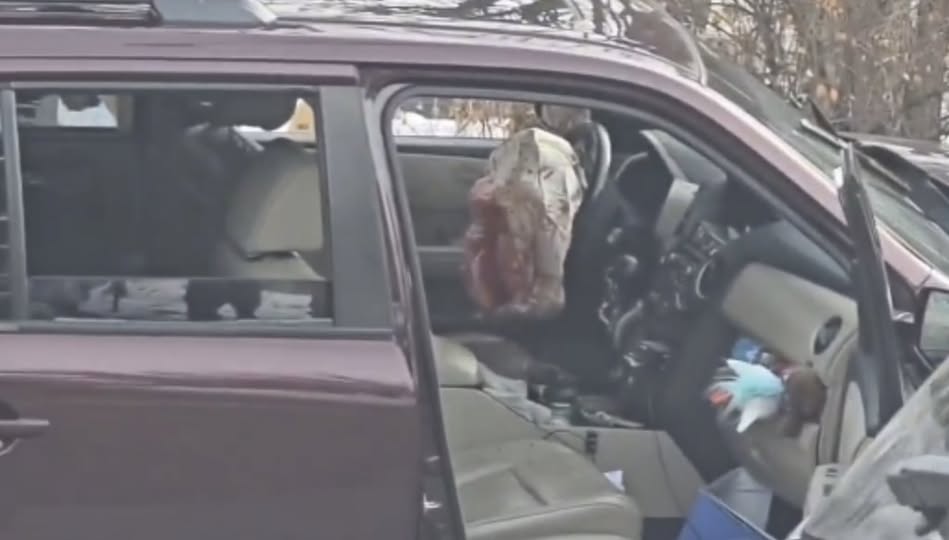
Protesters Surround Scene at 34th and Portland as CBP Chief Gregory Bovino Spotted on Site
MINNEAPOLIS, Minn. — A quiet residential intersection in South Minneapolis erupted into chaos and confrontation on Wednesday morning after federal law enforcement agents reportedly shot a woman during an immigration enforcement operation. Witnesses at the scene allege the woman was shot in the face while attempting to flee the area, sparking immediate outrage and drawing hundreds of protesters to the scene near George Floyd Square.
The shooting, which occurred shortly before 10:30 a.m. near East 34th Street and Portland Avenue, has plunged the city into a fresh crisis amid what federal officials have described as an intensified immigration crackdown across the Twin Cities.
As of Wednesday afternoon, the victim’s condition remains critical, with emergency medical personnel performing CPR on the scene before transporting her to a nearby trauma center. The incident has drawn a massive law enforcement response, including the confirmed presence of Customs and Border Protection (CBP) Chief Gregory Bovino, a high-profile and controversial figure in the federal government’s ongoing immigration enforcement initiatives.
Breaking: The Shooting at 34th and Portland
Details of the confrontation remain fluid, but witness accounts paint a harrowing picture of a federal operation spiraling into violence. According to residents, unmarked federal vehicles had converged on a property near the intersection earlier in the morning.
“They boxed a car in, and then I heard shouting,” said one witness, who identified herself as Sarah T., a resident of the Powderhorn Park neighborhood. “A woman was trying to get away—she wasn’t holding a weapon, she was just trying to run. Then pop, pop. She went down immediately. It looked like she was hit right in the face.”
Another witness, who was livestreaming the aftermath on social media, claimed the woman was inside a vehicle that attempted to maneuver around a federal blockade when agents opened fire. “They didn’t give her a chance,” the witness said on the stream. “They just started blasting.”
While federal agencies have not yet released an official narrative regarding the specific sequence of events, a source within the Department of Homeland Security (DHS) cited by CBS News suggested the incident may have involved a “vehicle ramming-related incident.” However, this claim has been met with skepticism by witnesses and local activists who assert the shooting was an excessive use of force against a fleeing subject.
Emergency medical services were dispatched at 10:32 a.m., with dispatch audio capturing the urgency of the situation. “Subject down, gunshot wound to the head, CPR in progress,” a first responder reported over the radio. Two EMS units were requested to stabilize the victim amidst a rapidly growing crowd of bystanders.
CBP Chief Gregory Bovino on Scene
A significant flashpoint in the developing situation is the presence of Gregory Bovino, a senior CBP official known for his aggressive stance on immigration enforcement. Bovino, who has been dubbed a “tactical commander” for recent high-visibility federal operations in cities like Los Angeles and Chicago, was photographed by local journalists behind the yellow police tape at 34th and Portland.
His presence in Minneapolis signals the high priority the federal government has placed on the current operation in Minnesota. Bovino has previously drawn national headlines for his direct involvement in field operations, a rarity for high-ranking agency chiefs. In late 2025, he faced scrutiny from a federal judge regarding allegations of lying about use-of-force incidents during protests in Chicago.
“Seeing Bovino here tells us this isn’t just a routine stop,” said Jason Chavez, a Minneapolis City Council member who arrived at the scene shortly after the shooting. “This is a coordinated, top-down attack on our community. He is here to oversee violence against our neighbors.”
Bovino was seen consulting with officers from Immigration and Customs Enforcement (ICE) and the Hennepin County Sheriff’s Office, who were providing perimeter support. He did not speak to the press.
Protests Erupt: ‘Get Out of Our City’
Within minutes of the shooting, neighborhood communication networks—many established in the wake of the 2020 unrest—mobilized hundreds of people to the intersection. By noon, a standoff had emerged between a wall of federal agents in tactical gear and a swelling crowd of protesters chanting “ICE out of Minneapolis” and “No justice, no peace.”
Tensions boiled over at approximately 12:15 p.m. when law enforcement deployed chemical irritants to push the crowd back from the crime scene tape. Canisters of tear gas were seen arcing into the street, sending protesters scrambling into nearby yards.
“We are not leaving,” shouted an organizer with the local immigrant rights group MIRAC (Minnesota Immigrant Rights Action Committee). “They come into our neighborhoods, shoot our people in the face, and expect us to stay home? We are here to witness what they are doing.”
The scene is reminiscent of the civil unrest that defined the area years ago. The shooting took place less than a half-mile from George Floyd Square, a detail that has added symbolic weight to the community’s anger. Many in the crowd wore gas masks and carried shields, indicative of a populace hardened by years of conflict with law enforcement.
Official Responses and Political Fallout
The political reaction was swift and furious, exposing a sharp divide between local leadership and federal authorities.
Minneapolis Mayor Jacob Frey issued a blistering statement on X (formerly Twitter) shortly after the news broke.
“We are aware of a shooting involving federal law enforcement near East 34th Street and Portland Avenue. The presence of federal immigration enforcement agents is causing chaos in our city. We’re demanding ICE to leave the city immediately. We stand rock solid with our immigrant neighbors.”
However, Mayor Frey also faced criticism from activists on the ground who noted that Minneapolis Police Department (MPD) officers were assisting with traffic control and perimeter security for the federal agents.
Governor Tim Walz also weighed in, confirming that the shooting was “ICE-related” and calling for calm while the Bureau of Criminal Apprehension (BCA) begins its investigation.
“My public safety team is working to gather information on an ICE-related shooting this morning,” Walz said in a press briefing. “We need facts, not speculation. I urge everyone to remain peaceful as we determine exactly what happened.”
In contrast, federal officials have remained largely silent. A brief advisory from DHS stated only:
“We are aware of a shooting involving federal law enforcement near East 34th Street and Portland Avenue. Please avoid this area.” No details regarding the officer involved, the specific agency (ICE, CBP, or HSI), or the justification for the use of deadly force have been provided.
The Context: A ‘Historic’ Crackdown
This shooting does not happen in a vacuum. It comes in the midst of what federal officials have termed the “largest immigration operation ever” in the Midwest. For the past week, reports have flooded in of ICE agents conducting sweeps in Minnetonka, Brooklyn Center, and South Minneapolis.
Unlike previous administrations which often focused on individuals with serious criminal records, the current operation appears to be indiscriminate, sweeping up anyone unable to provide immediate proof of legal status.
-
Courthouse Arrests: Earlier this week, ICE agents were filmed arresting individuals inside the Hennepin County Government Center, a move that public defenders argue violates the sanctity of the court system.
-
School Incidents: Rumors of agents near public schools have led to panic among parents, though these reports remain unverified.
-
“Block Watch” Defiance: In response, Minneapolis residents have organized elaborate spotting networks. Residents use encrypted chat apps to track the movement of unmarked SUVs, often arriving at arrest sites to film agents and disrupt detentions.
It was likely one of these spotting networks that alerted the community to the presence of agents at 34th and Portland this morning, leading to the rapid accumulation of witnesses.
Medical and Legal Status of the Victim
The identity of the woman shot has not been released. Sources at Hennepin Healthcare (HCMC) confirm that a female patient was admitted with a “severe gunshot wound to the facial region” and is currently in critical condition.
Civil rights attorneys are already arriving at the hospital and the scene. “If this woman survives, she will likely face federal charges to justify the shooting,” said a legal observer with the National Lawyers Guild. “That is the standard playbook. We are here to ensure her rights are protected and that evidence is not destroyed.”
No body-worn camera footage has been released. While local Minneapolis police are required to wear cameras, federal agents operate under different guidelines. Recent policy changes have expanded the use of body cameras for federal agents, but it remains unclear if the agents involved in this specific shooting were equipped with them or if the devices were activated.
Nightfall Brings Uncertainty
As evening approaches, the situation at East 34th Street and Portland Avenue remains volatile. The police perimeter has expanded, pushing protesters back to 35th Street. Floodlights have been brought in to illuminate the crime scene, where investigators are still marking shell casings and examining a sedan with shattered windows.
The presence of Gregory Bovino suggests that the federal government has no intention of backing down. His reputation as an enforcer who refuses to yield to local political pressure indicates that Minneapolis may be the epicenter of a prolonged struggle between federal immigration policy and local resistance.
“They picked the wrong city,” Council Member Chavez posted on social media late Wednesday. “Minneapolis fights back.”
Detailed Analysis: The Escalation of Federal Operations in 2026
The shooting at 34th and Portland is the most violent incident yet in a week of escalating tensions across Minnesota. To understand how a quiet Wednesday morning turned into a scene of bloodshed, it is necessary to examine the broader federal strategy currently in play.
The “Midway Blitz” Strategy
Sources indicate that the operation in Minneapolis is part of “Operation Midway Blitz,” a coordinated DHS campaign targeting sanctuary jurisdictions in the Midwest. The strategy involves flooding specific zones with high-tempo arrest teams drawn from CBP, ICE, and HSI (Homeland Security Investigations) units from around the country.
By saturating an area, federal authorities aim to overwhelm local “sanctuary” defenses—such as policies that prevent local police from cooperating with ICE detainer requests.
Chief Gregory Bovino’s Role: Bovino’s involvement is key to understanding the tactics used. Known for his aggressive interpretation of immigration law, Bovino has previously authorized the use of tactical units (BORTAC) for routine immigration arrests. BORTAC agents are essentially the SWAT team of the Border Patrol, trained for high-risk cartels and mountain warfare, not urban policing in residential Minneapolis.
If BORTAC agents were involved in the shooting at 34th and Portland, it would explain the “military-style” response described by witnesses. These units are often equipped with heavy body armor, long guns, and specialized breaching equipment.
Community Defense vs. Federal Force
Minneapolis has developed one of the most sophisticated anti-ICE infrastructures in the nation. Following the 2020 uprising, neighborhood groups remained organized.
-
Rapid Response Teams: When an ICE sighting is reported, “verifiers” are dispatched to confirm the presence of agents. Once confirmed, an alert goes out to thousands of subscribers.
-
Legal Observation: Trained volunteers arrive to document the interaction, write down badge numbers, and inform detainees of their rights.
-
Sanctuary Support: Churches and community centers open their doors to offer physical sanctuary to those targeted.
On Wednesday morning, this system was activated. Witnesses say that before the shooting, several civilian vehicles had arrived to monitor the federal agents. It is possible that the shooting occurred during a confrontation between agents and these community defenders, or during an attempt by the subject to escape the tightening net.
The Legal Battle Ahead
The shooting will trigger a complex jurisdictional battle.
-
Investigation: Who investigates federal agents who shoot a civilian? Typically, the state Bureau of Criminal Apprehension (BCA) leads the criminal probe, but the FBI will often launch a parallel civil rights investigation.
-
Supremacy Clause: Federal agents often claim immunity from local prosecution under the Supremacy Clause of the Constitution, provided they were acting within the scope of their duties. However, if the use of force is deemed “unreasonable” or “excessive,” that immunity can be pierced.
-
Witness Intimidation: Activists are already raising concerns that witnesses to the shooting—many of whom may be undocumented themselves—will be targeted for deportation to silence them. Mayor Frey’s demand for ICE to leave is partly an attempt to protect these witnesses.
Impact on the Immigrant Community
The psychological toll on Minneapolis’s immigrant community is immense. Schools in the Phillips and Powderhorn neighborhoods reported high absenteeism on Wednesday as parents kept children home out of fear.
“People are terrified to leave their houses,” said a representative from COPAL (Communities Organizing Latinx Power and Action). “This is terrorism. Driving down the street to get groceries could end with you being shot in the face. That is the message they are sending.”
Business owners on Lake Street, still recovering from economic instability, closed early on Wednesday in anticipation of nightly protests.
What Comes Next?
Immediate: The condition of the victim is the primary variable. If she succumbs to her injuries, the protests will likely intensify significantly. If she survives, her testimony will be the centerpiece of a legal firestorm.
Short-term: Mayor Frey and the City Council are expected to hold an emergency session to determine if the city can legally obstruct federal operations, perhaps by blocking roads or denying access to city infrastructure, though such moves would carry significant legal risk.
Long-term: The presence of Gregory Bovino suggests this operation is not over. Federal forces are likely to remain in the city for days or weeks. The standoff at 34th and Portland may be just the opening salvo in a bitter winter of discontent in the Twin Cities.
Authorities are urging anyone with video footage of the incident to come forward, though many are submitting evidence to private attorneys rather than the police, citing a lack of trust in law enforcement.
This is a developing story. Updates will be provided as more information becomes available.
Key Facts Summary:
-
Incident: Officer-involved shooting (Federal).
-
Location: E 34th St & Portland Ave, Minneapolis.
-
Time: Approx. 10:25 AM, Wednesday, Jan 7, 2026.
-
Victim: Adult female, shot in face, critical condition.
-
Suspects: Federal Agents (ICE/CBP/HSI).
-
Command: CBP Chief Gregory Bovino on site.
-
Status: Active investigation, large protests, area closed.
Leave a Reply