
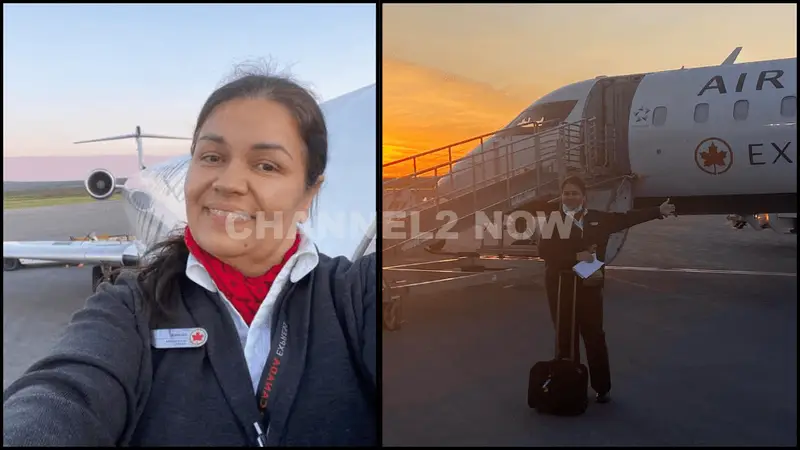
NEW YORK, N.Y. — In the grim history of aviation disasters, the phrase “ejected from the aircraft” almost never precedes the word “survived.” Yet today, the family of Solange Tremblay is using the word “miracle” to describe her escape from a catastrophic runway collision at LaGuardia Airport that has already claimed the lives of two dedicated pilots.
The National Transportation Safety Board (NTSB) has confirmed the harrowing details of Air Canada Express Flight 8646’s collision with a Port Authority fire truck.
As the Bombardier CRJ-900 completed its landing rollout, a multi-ton emergency vehicle—cleared in error to cross the active runway—impacted the nose of the jet with such velocity that it effectively de-coupled the cockpit from the rest of the fuselage. Solange Tremblay, a veteran flight attendant positioned in the forward jumpseat, was thrown into the night air as the hull breached. Found on the tarmac still buckled into her seat, she is now recovering from surgery for a broken leg, while the aviation world grapples with the loss of 30-year-old First Officer Antoine Forest.
This highly expansive, 2,000-word report delves into the “miracle” survival of Solange Tremblay, the professional legacy of Antoine Forest, the terrifying physical mechanics of a “nose-shearing” impact, the chilling ATC audio of the “messed up” emergency, and the broader, urgent calls for a total overhaul of runway incursion protocols.
The Survival: Solange Tremblay’s 100-Foot Journey
To fully comprehend the magnitude of Solange Tremblay’s survival, one must understand the structural limits of a regional jet. The CRJ-900 is a sleek, low-profile aircraft. The forward jumpseat is located immediately behind the cockpit bulkhead—the very area that bore the full kinetic energy of the Port Authority fire truck.
When the truck struck the nose, the aircraft’s forward section suffered what engineers call catastrophic structural failure. The nose was sheared off, creating a massive opening in the pressurized hull. Tremblay’s jumpseat, designed to remain secured to the floor or bulkhead, was ripped out of the aircraft.
According to her daughter, Sarah Lépine, Tremblay was thrown a significant distance from the main wreckage. “She was still in her seat on the ground,” Lépine shared. While the fall and the impact resulted in a severely broken leg requiring immediate surgical intervention, Tremblay did not sustain the fatal trauma experienced by the pilots just feet away. Her decades of experience and, perhaps, the specific angle of the ejection, allowed her to become a living witness to an “unthinkable” accident.
The Fallen: Antoine Forest’s Final Flight
While Tremblay’s story is one of survival, the community of Coteau-du-Lac, Quebec, is in a state of profound, absolute grief. Antoine Forest, 30, has been identified as the First Officer who perished in the crash.
Forest was a product of the prestigious aviation program at Cégep de Chicoutimi and was a veteran of northern and regional flying with operators like Air Saguenay and Exact Air. He joined Jazz Aviation in December 2022, fulfilling his dream of flying international routes for the Air Canada brand. Tributes from his former instructors and colleagues describe him as a “natural pilot” with a “calm and precise” demeanor—traits that were tragically insufficient against the mass of a responding fire truck.
The Mechanics of Chaos: Surveillance and ATC Audio
The investigation has been accelerated by two key pieces of evidence: newly released surveillance footage and the chilling recordings from the LaGuardia tower.
The Video: Surveillance cameras captured the CRJ-900 traveling at a high taxi/rollout speed when the fire truck entered its path. The video shows the truck attempting to brake at the last millisecond, but the momentum was too great. The “spectacular and terrifying” impact shows the nose of the jet effectively “disintegrating” upon contact with the truck’s reinforced chassis.
The Audio: Air traffic control recordings have laid bare the human error at the heart of the disaster. A controller can be heard clearing the fire truck to cross the runway to attend to a separate “odor emergency” on another plane. Moments later, realizing the landing Air Canada jet was still on the runway, the controller began screaming: “Stop, stop, stop… Truck 1, stop!” In a rare and heartbreaking admission of error, the controller later stated: “We were dealing with an emergency and I messed up.”
The Triage: 41 Rushed to NYC Trauma Centers
While the focus remains on the cockpit and forward galley, the 72 passengers in the cabin experienced a violent, jarring deceleration. A total of 41 individuals required hospitalization. Most have been treated for minor trauma and released, but the psychological scars of seeing their aircraft’s nose sheared off remain.
Injuries were also reported among the firefighters aboard Truck 1. The impact with a regional jet at speed is comparable to a high-speed highway collision, and the crew of the truck is also being evaluated for both physical injuries and the trauma of the event.
Conclusion: A Search for Systemic Safety
As the NTSB downloads the “Black Boxes” and Solange Tremblay begins her long road to recovery, the aviation industry is facing a moment of reckoning. The “Solange Miracle” is a light in a dark story, but it does not erase the systemic failures that allowed a fire truck and a passenger jet to occupy the same space at the same time.
The investigation into the LaGuardia runway disaster remains “active and ongoing.” The goal is clear: to ensure that the “nose-shearing” violence of Flight 8646 is the last of its kind.
Leave a Reply