
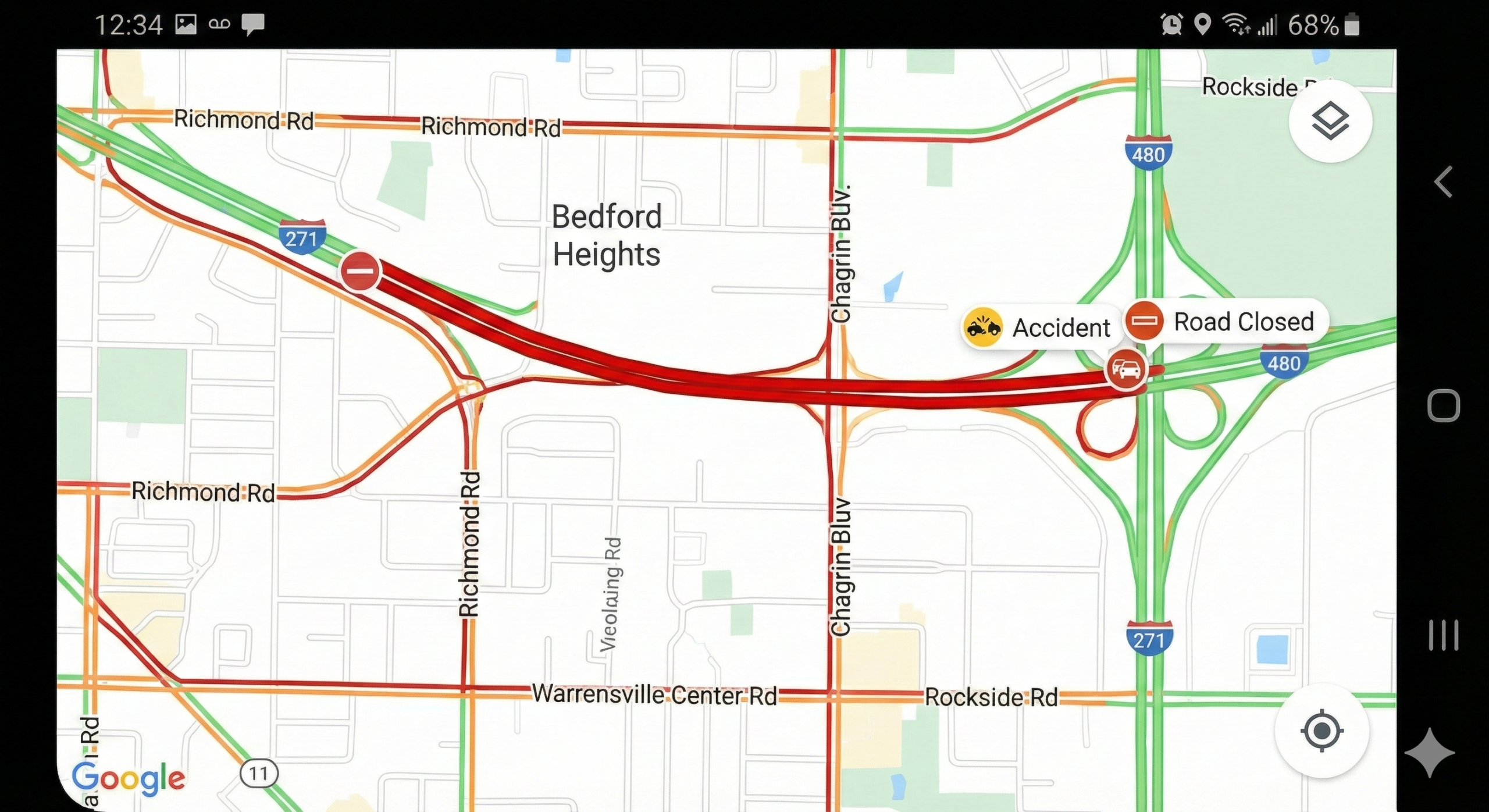
BEDFORD HEIGHTS, Ohio — A seemingly routine Saturday afternoon commute has dissolved into chaos for thousands of Northeast Ohio drivers, as a catastrophic vehicle collision has forced the total closure of Interstate 271 Southbound in Bedford Heights.
As of late afternoon on Saturday, February 7, 2026, a stretch of one of the region’s most vital commercial and commuter arteries has been transformed into a parking lot. Emergency responders from multiple jurisdictions are currently swarming the scene near the I-480 interchange, battling against time to aid victims and secure a crash site that witnesses are describing as “devastating” and “extensive.”
While official details remain sparse as the situation is active and fluid, the impact is undeniable: I-271 South is effectively closed, and the ripple effects are paralyzing traffic throughout the southeastern suburbs of Cleveland.
The Incident: A Saturday Standstill
The first signs of trouble began shortly after 1:00 p.m., when traffic flow on I-271 South—typically brisk on a Saturday—suddenly compressed. Within minutes, brake lights turned into a sea of red stretching from the Bedford Heights area back toward Beachwood and Pepper Pike.
According to unconfirmed reports and chatter on local traffic monitoring platforms, the incident occurred in the express lanes near the dangerous and complex merge point with Interstate 480. This particular stretch of highway is a notorious choke point where high-speed through-traffic mixes with vehicles attempting to exit or merge from local lanes, creating a volatile environment for motorists.
Initial dispatch reports, though unverified by official press release, suggest a multi-vehicle collision involving potential entrapment. Witnesses stuck in the backlog have taken to social media platforms to describe a scene of frantic activity, with multiple ambulances, fire engines, and police cruisers weaving through the stalled cars to reach the point of impact.
“We haven’t moved an inch in 45 minutes,” posted one user on a local community forum. “I can see lights flashing way ahead, maybe a mile down. People are actually turning their engines off. It looks bad.”
Another driver, stuck near the Harvard Road overpass, reported seeing heavy rescue equipment—often used to extract victims from crushed vehicles—racing down the shoulder. “When you see the big heavy rescue trucks going past you on the berm, you know it’s not just a fender bender,” the driver noted.
The Scene on the Ground
For those trapped in the queue, the Saturday afternoon plans of shopping, visiting family, or heading to work have been indefinitely suspended. The scene on I-271 South is one of eerie stillness amidst the concrete.
Reports indicate that some motorists, realizing the longevity of the shutdown, have stepped out of their vehicles to stretch their legs or check for updates on their phones—a dangerous but common reaction during “level 3” traffic incidents where the highway is completely impassable.
The view from the northbound lanes, which remain open but are suffering from “gaper delays” as drivers slow down to look, paints a grim picture. Observers describe a debris field scattered across all southbound lanes, necessitating a complete halt to traffic to preserve evidence and protect the first responders working in the roadway.
The specific number of vehicles involved has not been confirmed, though anecdotal evidence points to at least three vehicles, including a commercial truck or SUV, based on the size of the wreckage visible from a distance. The presence of a “major slowdown” reported by commuters suggests that the cleanup operation will be measured in hours, not minutes.
The Location: The “Split” and Its Dangers
To understand the severity of this crash, one must understand the geography of the crash site. The stretch of I-271 through Bedford Heights, particularly near the I-480 interchange (often referred to locally as “The Split”), is a marvel of engineering that is also fraught with peril.
Here, the highway divides into “Express” and “Local” lanes. While designed to separate long-distance travelers from local commuters exiting at Chagrin Blvd, Harvard Rd, or Rockside Rd, the configuration requires drivers to make split-second decisions at high speeds.
-
The Crossover Hazard: The areas where drivers can switch between Express and Local lanes are frequent sites of sideswipe accidents and high-speed rear-end collisions. If a driver realizes too late they are in the wrong lane, sudden lane changes can lead to disaster.
-
The Speed Differential: Vehicles in the Express lanes are often traveling well above the speed limit, while traffic in the Local lanes may be slowing for exits. When these two flows interact near the interchange, the kinetic energy involved in a crash is massive.
-
The Curve: The highway in this area features sweeping curves and elevation changes that can limit sightlines, meaning a stopped car ahead might not be visible until it is too late to stop.
Local residents know this stretch well. “It happens almost every month,” says Sarah Jenkins, a resident of nearby Solon who uses I-271 daily. “You hold your breath going through the Split. People drive too fast, they weave in and out, and there’s no room for error. When I heard the highway was shut down, I wasn’t surprised, just sad.”
Emergency Response: Anatomy of a Shutdown
A closure of this magnitude triggers a massive, coordinated response from multiple agencies.
-
Police: The Bedford Heights Police Department likely has primary jurisdiction, but given the scale, they are almost certainly being assisted by the Ohio State Highway Patrol (OSHP) and neighboring departments like Solon or Warrensville Heights to manage traffic control.
-
Fire & Rescue: Fire crews are tasked with medical care, extrication (cutting victims out of cars), and mitigating hazards like fuel spills or fire risks.
-
ODOT: The Ohio Department of Transportation plays a critical role in shutting down the on-ramps. Their “Help Trucks” and signage trucks are likely currently positioned miles upstream, diverting traffic away from the disaster zone.
-
Crash Reconstruction: If injuries are life-threatening or fatal, the investigation shifts from a simple cleanup to a forensic operation. The Crash Reconstruction Unit will be called in. These specialists use drones, lasers, and spray paint to map every skid mark, debris pile, and impact point. This process alone can take 2 to 4 hours, during which the road must remain closed to preserve the “crime scene.”
The Ripple Effect: Surface Streets Paralyzed
The closure of an interstate like I-271 acts like a dam break; the water must go somewhere. In this case, the “water” is thousands of displaced vehicles flooding onto surface streets that were never designed to handle interstate volume.
As of 2:30 p.m., traffic apps like Waze and Google Maps are showing deep red congestion lines on:
-
Richmond Road: Running parallel to the highway, this road is taking the brunt of the diverted traffic. Intersections at Chagrin Blvd and Harvard Rd are reportedly gridlocked.
-
Warrensville Center Road: Another north-south alternative, currently seeing heavy delays.
-
Rockside Road: As drivers attempt to cut through Bedford to reach I-480 West or I-77, this major commercial corridor is backing up significantly.
-
Northfield Road (Route 8): A popular bailout route for those heading toward the racino or Macedonia, now clogged with frustrated commuters.
Local police in these jurisdictions are likely scrambling to manually control traffic lights to flush the volume through, but the sheer number of cars means delays are inevitable. Residents in these areas should expect difficulty pulling out of driveways or navigating local intersections for the remainder of the afternoon.
February in Northeast Ohio: A Factor?
While the official cause is unknown, the date—February 7—cannot be ignored. Winter in Northeast Ohio is unpredictable. Even if snow is not actively falling, February roads can be treacherous.
-
Black Ice: Bridges and overpasses, like the massive structures at the I-271/I-480 interchange, freeze faster than regular pavement. A patch of invisible ice in a shadow can send a car spinning into a barrier or another vehicle instantly.
-
Sun Glare: On bright winter afternoons, the low angle of the sun can be blinding to drivers heading south, potentially obscuring a slowed vehicle ahead.
-
Road Grime: Salt and spray can coat windshields, reducing visibility.
Investigators will look at all these environmental factors as they piece together what happened. Was it weather-related? Was it distracted driving? Was it a mechanical failure? Or was it simply the result of congestion meeting speed?
What Drivers Should Do Now
If you are reading this and are not yet on the road, the message from officials is clear: Avoid I-271 South entirely.
-
From the North (Mayfield/Lyndhurst): Exit early. Take surface streets like Brainard or Lander, though expect delays. Consider cutting over to I-90 or I-77 if your destination allows.
-
Stuck in the Backup: Do not attempt to drive the wrong way up an on-ramp or cross the grassy median to the local lanes unless directed by police. This creates secondary accidents and blocks emergency vehicles. Stay in your car, keep your seatbelt on, and wait for instructions. Police will eventually “flush” the traffic, likely by directing cars to turn around or guiding them past the scene on the shoulder once it is safe.
-
Near the Scene: If you witnessed the crash, contact the Bedford Heights Police or OSHP immediately. Your dashcam footage or testimony could be the key to understanding how this tragedy unfolded.
A Community Waiting for Answers
As the sun begins to lower on this Saturday afternoon, the focus remains on the victims. The “unconfirmed reports” of serious injuries hang heavy over the situation. In the age of social media, rumors fly fast—claims of a LifeFlight helicopter landing, or of a semi-truck jackknifed—but until official word comes, these remain speculation.
What is certain is that lives have been changed today. For the families of those involved, a phone call is coming—or has already come—that no one ever wants to receive. For the first responders, it is another day of witnessing trauma on the roads they protect. And for the community of Bedford Heights and the wider Cleveland area, it is a stark reminder of the violence that can occur in the blink of an eye on our high-speed networks.
We are monitoring official channels from the Ohio Department of Transportation and local law enforcement. As soon as verified information regarding the number of vehicles, the condition of the victims, and the estimated reopening time of the highway becomes available, we will update this report.
For now, the lights flash, the sirens wail, and the traffic sits still on I-271 South.
DEVELOPING STORY: Check back for updates. If you have photos or information from the scene (taken safely), please contact our news desk.
Leave a Reply