
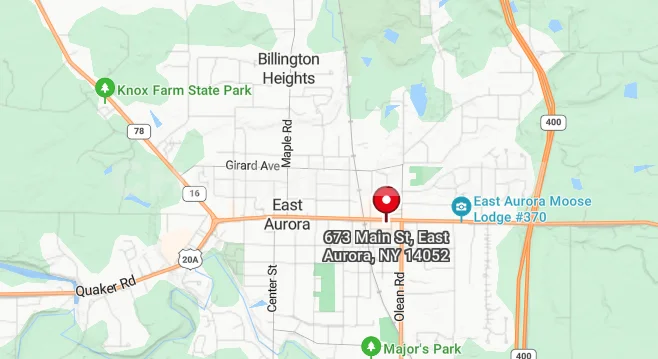
EAST AURORA, N.Y. — A terrifying scene unfolded inside the beloved and historic Aurora Theatre on Main Street this Sunday, as a portion of the ceiling suddenly collapsed while dozens of students and chaperones were gathered below. The incident, which officials say was triggered by ongoing construction activity within the century-old building, resulted in minor injuries to six children and sent shockwaves through the quiet Village of East Aurora.
Emergency crews rushed to the scene at 673 Main Street shortly after the collapse was reported. First responders were met with a chaotic situation as adults hurried to evacuate approximately 68 students and chaperones from the dust-filled auditorium.
While the potential for a mass casualty event was terrifyingly real, officials confirmed that a major tragedy was narrowly averted. There was no entrapment under the rubble, and no serious or life-threatening injuries were reported. Emergency Medical Services (EMS) evaluated six pediatric patients at the scene for minor injuries, including bumps, bruises, and dust inhalation.
The incident has immediately triggered a safety review and a halt to operations at the theater. Authorities have confirmed that construction work was taking place inside the two-story brick structure at the same time the event was being held—a decision that is now the subject of intense scrutiny by local code enforcement and fire safety officials.
Panic on Main Street: The Incident Unfolds
Sunday afternoons in the Village of East Aurora are typically idyllic, with residents and visitors strolling down Main Street to visit local landmarks like Vidler’s 5 & 10 or the Roycroft Campus. The Aurora Theatre, with its iconic neon marquee, is the heartbeat of that downtown strip.
However, that peace was shattered on Sunday, December 14, 2025. Inside the theater, a group of students and their adult chaperones were settling in for a scheduled event. It was meant to be an afternoon of entertainment, but it quickly turned into a nightmare.
Witnesses described a sudden, ominous cracking sound from above, followed almost instantly by the crash of falling debris. A section of the ceiling, comprised of heavy plaster and lath typical of older buildings, gave way, raining down dust and material onto the seating area below.
“It happened so fast,” said one parent who arrived at the scene shortly after the collapse. “One minute they were watching the screen, and the next minute there was a cloud of dust and screaming. You send your kids on a field trip or a movie outing thinking they are safe. You never imagine the roof is going to fall in on them.”
The collapse created an immediate cloud of choking dust that obscured visibility and added to the panic. Chaperones and theater staff sprang into action, shouting for the children to keep their heads down and move toward the exits. The evacuation was rapid but chaotic, as 68 people scrambled to get out of the darkened theater, unsure if more of the ceiling was about to come down.
The Emergency Response: A Community Mobilized
The East Aurora Fire Department, along with mutual aid from neighboring districts and the East Aurora Police Department, responded within minutes. The call—”ceiling collapse with children involved”—is one of the most dreaded dispatches a first responder can receive.
As sirens wailed down Main Street, a triage area was quickly established on the sidewalk outside the theater. Firefighters entered the building to ensure no one was trapped beneath the fallen debris. To the immense relief of the community, they confirmed that the collapse was “limited in scope”—meaning only a section had fallen rather than the entire roof structure—and that everyone had been accounted for.
“First responders confirmed there was no entrapment,” a police spokesperson stated. In the context of structural collapses, this was the best possible news.
Outside, paramedics moved from child to child, checking for concussions, lacerations, and respiratory issues caused by the debris and dust. Six students were identified as having sustained injuries. They were treated on-scene for what officials described as “minor injuries.” While no one required emergency transport to a trauma center, the psychological impact on the children—many of whom were shaken and crying—was evident.
Parents who had been alerted to the incident began arriving on Main Street, their faces etched with fear until they were reunited with their children. Police cordoned off the block to manage the traffic and the growing crowd of concerned onlookers.
The Cause: Construction During an Event?
As the dust settled, the focus of the investigation turned immediately to why the ceiling had failed. The Aurora Theatre is a historic building, and like many structures of its age, it requires maintenance. However, preliminary findings from the investigation point to a specific and troubling cause: active construction.
Officials stated that “construction activity inside the two-story brick structure led to a portion of the ceiling giving way.”
This revelation has raised serious questions about safety protocols. It is generally standard practice in building management to halt heavy construction or structural work while the public—especially a large group of children—is present in the facility. Vibrations from tools, the shifting of weight on upper floors, or the disturbance of load-bearing elements can easily destabilize fragile plaster ceilings in historic structures.
Investigators from the Village of East Aurora Building Department and fire safety inspectors spent hours inside the theater on Sunday evening conducting a structural assessment. Their primary goal was to determine if the rest of the building remained stable or if there was a risk of further collapse.
“The incident remains under review, including the circumstances surrounding the construction work that preceded the collapse,” authorities said in a statement.
Key questions that investigators will be asking include:
-
What specific type of construction was being performed?
-
Was a permit issued for this work?
-
Did the work plan account for the fact that the theater would be occupied?
-
Were the contractors aware that an event with 68 people was taking place directly below or adjacent to their work zone?
The Aurora Theatre: A Village Landmark
To understand the impact of this event, one must understand the significance of the Aurora Theatre. Located at 673 Main Street, the theater is not just a business; it is a beloved institution in East Aurora.
Opened in 1925, the theater is a classic example of early 20th-century cinema architecture. For generations of East Aurora residents, it has been the place for first dates, Saturday matinees, and community gatherings. Its vintage aesthetic, single-screen charm (though later modernized), and prominent location make it a centerpiece of the village’s historic district.
The building itself is a solid, two-story brick structure that has withstood decades of Western New York winters. However, historic buildings are living entities that require careful handling. The plaster ceilings found in theaters of this era are often suspended from the roof trusses by wire or wood lath. Over time, these connections can become brittle. If construction work disturbs these connections—through hammering, drilling, or walking on the joists above—a “keyed” plaster ceiling can lose its grip and fail catastrophically.
The community’s love for the theater is deep, which makes the news of the collapse all the more distressing. Residents want to see the theater thrive, but they also demand that it be safe. The trust between the venue and the community has been shaken, and rebuilding that trust will require total transparency about what went wrong on Sunday.
The “Pediatric Patients”: A Field Trip Gone Wrong
The presence of children transforms this from a property damage story into a human interest tragedy. While the specific group hosting the event has not been named in the initial reports, the ratio of students to chaperones suggests a school field trip, a youth group outing, or a private party.
For the 68 people inside, the event was supposed to be a joyous occasion. The trauma of a structural collapse can be lingering.
“Emergency Medical Services evaluated six pediatric patients for minor injuries,” the report noted. In the medical world, “pediatric” refers to anyone under the age of 18, but the presence of chaperones suggests these were likely school-aged children.
The injuries likely included:
-
Contusions/Bruising: From falling pieces of plaster or drywall.
-
Abrasions: Scratches from debris.
-
Respiratory Irritation: Old plaster dust contains decades of particulate matter, which can be extremely irritating to young lungs and eyes.
The psychological toll is also a factor. “My son is afraid to go back inside any big building right now,” one parent posted on a local community forum. “He thinks the roof is going to fall.”
Structural Integrity and “The Swiss Cheese Model”
Safety experts often refer to the “Swiss Cheese Model” of accident causation. This theory suggests that a disaster occurs when the “holes” in multiple layers of defense line up. In the case of the Aurora Theatre collapse, investigators will be looking for those holes:
-
Layer 1: The Age of the Building. Old plaster is inherently heavy and brittle.
-
Layer 2: Maintenance History. Had the ceiling been inspected recently? Were there signs of sagging or cracking that were ignored?
-
Layer 3: The Construction. The active trigger. Was the work too aggressive for the building’s age?
-
Layer 4: Scheduling. The decision to allow an audience inside while work was ongoing.
It appears that all these layers aligned on Sunday. The construction likely provided the vibration or physical shock needed to detach a section of the aging ceiling, which then fell into the occupied space.
Code enforcement officers will be reviewing the permits filed for the construction. If the work was unpermitted, or if the permit stipulated that the building must be vacant during the work, the theater’s ownership could face significant fines and legal liability.
What Happens Next?
The Aurora Theatre is now closed indefinitely. Before it can reopen, a rigorous series of steps must be taken:
-
Full Structural Audit: Engineers must inspect every square inch of the remaining ceiling. If one section failed, the rest is suspect. It is likely that the entire ceiling will need to be reinforced or replaced to ensure public safety.
-
Code Compliance Review: The Village of East Aurora will review all construction activities to ensure they meet New York State building codes.
-
Cleanup: The theater must be professionally cleaned to remove the debris and the fine dust, which can linger in HVAC systems and upholstery.
-
Public Reassurance: The theater management will need to communicate clearly with the public about the steps taken to ensure this never happens again.
This incident also serves as a wake-up call for other historic venues across the state. It highlights the critical importance of coordinating maintenance schedules with public events. The rule of thumb in facility management is simple: Heavy construction and public occupancy do not mix.
A Community Grateful, Yet Angry
As night fell on East Aurora Sunday, the flashing lights of the emergency vehicles were replaced by the glow of the streetlamps, but the mood in the village remained tense.
There is an overwhelming sense of gratitude that the injuries were not worse. A ceiling collapse in a theater can easily be fatal—heavy chunks of plaster falling from 20 or 30 feet can cause severe head trauma. The fact that everyone walked out, albeit dusty and shaken, is being hailed as a miracle.
However, there is also anger. Parents and community members are demanding answers. Why was construction happening on a Sunday during a student event? Who authorized it? Why wasn’t the area cordoned off?
“We were lucky today,” said a local fire official off the record. “Extremely lucky. But luck isn’t a safety strategy. We need to know why this happened so we aren’t relying on luck next time.”
For now, the marquee at the Aurora Theatre is dark. The show cannot go on—not until the people of East Aurora can be assured that the roof over their heads is safe.
Further information will be released as the investigation continues. The Village of East Aurora officials are expected to provide an update on the building’s status and any potential code violations later in the week.
Leave a Reply