
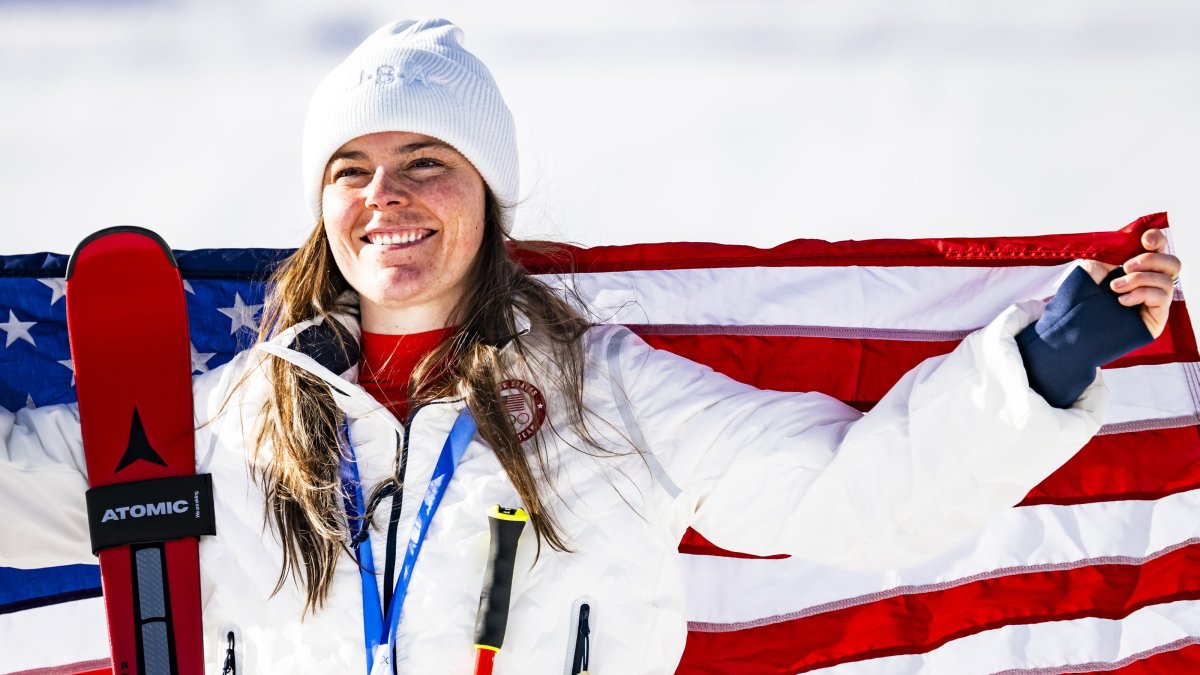
Lindsey Vonn Suffers Horrific Crash at Milano Cortina Olympics, Airlifted as Breezy Johnson Wins Women’s Downhill Gold Over Emma Aicher and Sofia Goggia.
A Crown of Gold and a Crown of Thorns: Triumph and Tragedy in Cortina
The Olympia delle Tofane course in Cortina d’Ampezzo, a storied battleground nicknamed the “Pearl of the Dolomites,” bore witness to a day of starkly contrasting destinies on Sunday at the Milano Cortina 2026 Winter Games. Under a piercingly blue Italian sky, the women’s downhill event delivered both historic jubilation and heart-stopping terror, encapsulating the razor-thin line between glory and catastrophe that defines alpine skiing. Breezy Johnson stood atop the podium, becoming just the second American woman to claim Olympic downhill gold. Yet, her moment of triumph was irrevocably shadowed by the sight of a medical helicopter lifting off from the mountain, carrying her idol and teammate, the legendary Lindsey Vonn, to an uncertain fate after a catastrophic crash seconds into her run.
The Fateful Run: Thirteen Seconds of Agony
The atmosphere was electric as Vonn, the 41-year-old icon, pushed out of the start gate. Her comeback story—defying age, a partial titanium knee replacement, and a devastating crash just nine days prior—was the headline of the Games. Cameras panned to her father, Alan Kildow, and a celebrity-packed crowd including rapper Snoop Dogg.
Her run lasted merely 13 seconds.
Video analysis shows Vonn, attacking the opening traverse with characteristic aggression, cut the line a fraction too tightly. Her right ski lost purchase on the hard, icy surface. In an instant, she was launched into the air, her body spinning violently before crashing onto the slope with immense force, tumbling and sliding into the safety netting. The stadium’s roar turned to a collective gasp. Broadcast audio captured a piercing scream, followed by an eerie silence broken only by the rush of ski patrol and medical personnel.
The response was swift and grave. Medical teams, including a specialized orthopedic trauma unit stationed on-site for the Games, reached Vonn within minutes. After a lengthy on-hill assessment, she was fully immobilized, carefully placed on a gurney, and airlifted via helicopter to the Ospedale di Cortina for emergency evaluation. The U.S. Ski Team’s initial statement was terse, confirming only that she was “conscious” and would undergo further evaluation.
Breezy Johnson’s Bittersweet Ascent to Glory
As the course was cleared and the race resumed after a 45-minute delay, the remaining skiers faced an impossible task: compartmentalizing the trauma they had just witnessed to focus on the Olympic prize. Breezy Johnson, starting later in the order, channeled a tumultuous mix of emotions into a run of flawless, aggressive precision.
“My heart is with Lindsey. Everything I’ve learned about resilience, I learned from watching her,” a tearful Johnson said immediately after her run, unaware she had secured gold. “To win this, on this hill, with her legacy everywhere… it’s overwhelming.”
Johnson’s victory, with a time of 1:43.21, was a masterclass in controlled fury. She bested a fierce field, including Germany’s Emma Aicher (1:43.58), who took a surprise silver, and the local hero, Italy’s Sofia Goggia (1:43.67), the bronze medalist. Johnson’s name now joins an elite shortlist: she is only the second American woman to win Olympic downhill gold, following Vonn’s own triumph in Vancouver 2010. The podium ceremony was a somber affair, with athletes and spectators alike grappling with the day’s duality.
The Anatomy of a Comeback and a Catastrophe
Vonn’s crash was not a random accident but the tragic crescendo of a high-wire act of defiance. Her journey to these Games was itself miraculous:
· The “Bionic” Knee: After years of punishment, Vonn underwent a groundbreaking partial titanium knee replacement in 2022, a procedure rarely seen in elite athletes.
· Defying Time: Against all medical expectations, she returned to the World Cup circuit last season, not just to participate but to dominate, leading the downhill standings coming into Cortina.
· The Final Setback: Just nine days before the Olympic race, a training crash in Switzerland left her with a ruptured ACL, a bone bruise, and meniscus damage—injuries that would end any normal athlete’s season. Vonn, true to form, vowed to compete.
This history made the crash particularly chilling. International Ski and Snowboard Federation (FIS) president Johan Eliasch, speaking to press, called it “a tragic moment for our sport,” emphasizing that Vonn was a “warrior who understood and accepted the risks.” Biomechanics experts later suggested that the compromised stability from her recent knee injuries, combined with her signature aggressive line, likely contributed to the inability to recover from the initial slip.
Cortina: A Kingdom and a Crucible
The location added a layer of profound irony. Cortina is Vonn’s kingdom. With a record 12 World Cup downhill victories on this very course, she earned the nickname “Queen of Cortina.” The Tofane piste is where she built her legend; on this day, it threatened to end it. Her two training runs earlier in the week had been solid, fueling belief in one last, storybook chapter. Instead, the mountain she mastered posed a final, unforgiving question.
The Fallout: Safety, Legacy, and an Uncertain Future
The incident immediately reignited global debates about safety in alpine skiing. The speed, equipment, and course-setter’s challenge to find the limit between “difficult” and “dangerous” are perennial topics. Vonn’s crash, witnessed by millions, will undoubtedly prompt FIS to review safety protocols for future courses, particularly on the high-speed traverses where such high-impact accidents can occur.
More immediately, the question hangs over Vonn’s future. Having returned from a dozen major surgeries, the scale of these new injuries—coming on top of the recent ACL rupture—poses the most serious threat yet to her career. While no official prognosis was given, the nature of the crash and her medical history suggests a recovery measured in years, not months.
A Community in Mourning, a Champion in Waiting
The alpine skiing world, a tight-knit family despite intense competition, unified in its support. Rivals past and present flooded social media with messages of love for Vonn and congratulations for Johnson. Johnson herself dedicated her gold medal to her fallen teammate, vowing to be a steward of Vonn’s legacy.
For Breezy Johnson, the day was the culmination of a career often marred by her own injuries. Now 30, she has finally stepped out from the long shadow of her mentor to claim the sport’s ultimate prize. Yet, the gold medal will forever be linked to the image of the helicopter against the Dolomites. Her victory secures her place in the record books, but the day’s events impress upon her a heavier crown: the responsibility of leading American skiing into a new era, while never forgetting the cost at which it sometimes arrives.
As night fell on Cortina, the flags of the medalists fluttered in the mountain breeze. The story of the day, however, was not about who stood on the podium, but about who was absent from it, and the brutal reminder that in the chase for Olympic immortality, the mountain always has the final say. The world now awaits news on Lindsey Vonn’s condition, hoping the Queen of Cortina can, once more, defy the odds.
Leave a Reply