
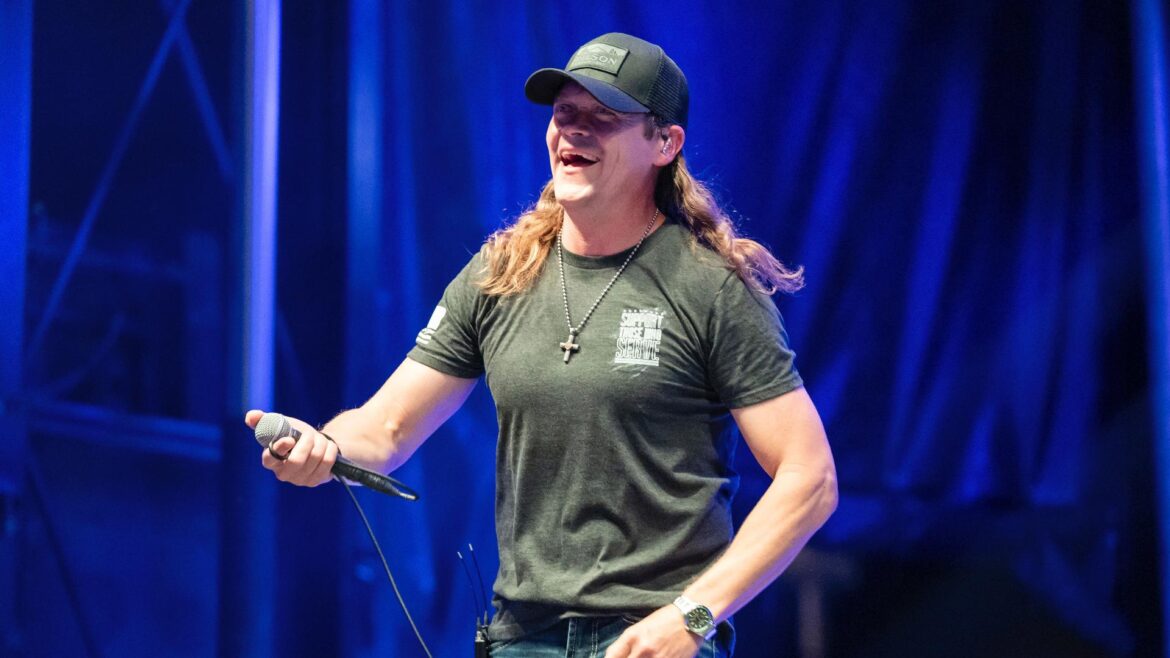
ESCATAWPA, Miss. — The rock world has lost one of its most distinct and enduring voices. Brad Arnold, the founding member, lead vocalist, and songwriter of the multi-platinum band 3 Doors Down, has died. He was 47 years old.
The news was confirmed by the band in an emotional statement released on Saturday, February 7, 2026, sending shockwaves through a fanbase that spans generations. Arnold, whose soaring vocals and honest lyrics defined the post-grunge era of the early 2000s, passed away peacefully in his sleep, surrounded by his wife, Jennifer, and his family.
His death follows a private and courageous battle with Stage 4 clear cell renal cell carcinoma, a diagnosis he publicly shared in May 2025. While his physical presence is gone, the legacy he leaves behind—etched in the lyrics of anthems like “Kryptonite,” “When I’m Gone,” and “Here Without You”—remains immortal.
Breaking: A Quiet Exit for a Loud Soul
The announcement came on a somber Saturday morning. “With heavy hearts, we share the news that Brad Arnold… passed away on Saturday, February 7th,” the band’s statement read. According to representatives, Arnold died “surrounded by love.”
-
The Final Moments: He passed away in his sleep, a peaceful end to a grueling fight against an aggressive disease.
-
The Support System: His wife, Jennifer Sanderford, whom he married in 2009, was by his side, along with close family members. Jennifer, a childhood friend who reconnected with Brad later in life, was described as his rock throughout his treatment.
The Battle with Cancer: The tragedy of his death is compounded by the suddenness of his decline. In May 2025, less than a year ago, Arnold posted a candid video to social media revealing his diagnosis. He had been feeling unwell and, after a hospital visit, learned he had clear cell renal cell carcinoma—the most common form of kidney cancer in adults.
-
Aggressive Spread: By the time it was discovered, the cancer was already at Stage 4 and had metastasized to his lungs.
-
Unwavering Faith: Despite the grim prognosis, Arnold approached his illness with the same grit that defined his music. In his announcement, he told fans, “We serve a mighty God, and he can overcome anything. So I have no fear. I really, sincerely am not scared of it at all.”
-
The Music Stopped: The diagnosis forced the band to cancel their highly anticipated 2025 summer tour, marking one of the few times in their 30-year history that the road went quiet.
The Early Years: From Math Class to Stardom
To understand the magnitude of Brad Arnold’s loss, one must look back to Escatawpa, Mississippi, in the mid-1990s. Arnold was not a polished industry product; he was a teenager with a drum kit and a notebook.
-
The Origin Story: In 1996, Arnold formed 3 Doors Down with guitarist Matt Roberts and bassist Todd Harrell. Uniquely, Arnold was originally the band’s drummer and singer, pounding the skins while belting out melodies—a rare feat that showcased his raw talent.
-
“Kryptonite”: The song that would change his life forever was written during a mundane moment. Arnold famously penned the lyrics to “Kryptonite” while sitting in a high school math class at age 15. He was drumming on his desk, humming the melody, and writing words that would eventually be sung by millions.
-
The Breakout: That song, recorded as a demo, became a local radio phenomenon on WCPR-FM in Biloxi. The grassroots success led to a major label deal with Republic Records, and in 2000, the band released their debut album, The Better Life.
The Soundtrack of a Generation
3 Doors Down arrived at the perfect moment. As the grunge movement of the 90s faded, listeners were hungry for rock that was accessible, melodic, and emotionally resonant. Brad Arnold became that voice. The Better Life went on to be certified 7x Platinum, fueled by “Kryptonite,” “Loser,” and “Duck and Run.” But Arnold proved he was no one-hit wonder.
-
“Away From the Sun” (2002): The band’s sophomore album solidified their status as rock giants. Ballads like “Here Without You” showcased Arnold’s softer side, becoming a staple at proms, weddings, and military deployments. The track “When I’m Gone” became an anthem of resilience, particularly for U.S. troops serving overseas, a community Arnold championed throughout his career.
-
The Lyricist: Arnold’s writing style was simple but profound. He didn’t hide behind metaphors. He wrote about loneliness, addiction, hope, and the struggle to find one’s place in the world. As the band noted in their tribute, his songs “created moments of connection, comfort, and shared experience.”
Personal Struggles and Redemption
Brad Arnold’s life was not without its shadows. Like many who rise to fame quickly, he battled personal demons. He was open about his struggles with alcohol addiction, a battle that threatened his health and his career.
-
Sobriety: In 2016, Arnold made the life-changing decision to get sober. He often spoke about this journey in interviews, crediting his recovery to his faith and his desire to be a better husband and bandmate.
-
Faith: In his later years, Arnold became increasingly vocal about his Christian faith. It was the lens through which he viewed his cancer diagnosis, refusing to let fear dominate his final months. He often ended concerts by telling the crowd, “Jesus Christ loves you,” a message he delivered with sincerity.
A Legacy Beyond the Stage
The outpouring of grief following his death highlights the connection he built with fans.
-
The Everyman: Brad Arnold never acted like a rock star. He wore t-shirts and jeans. He spoke with a thick Southern drawl. He was humble. Fans tell stories of him staying late to sign autographs, of his genuine smile during meet-and-greets, and of the way he looked people in the eye.
-
The Philanthropist: Through the The Better Life Foundation, which the band established in 2004, Arnold helped raise millions for children in need, disaster relief efforts, and veteran support.
Tributes Pour In
As news of his passing spread on Saturday, the music world began to react.
-
The Band’s Tribute: 3 Doors Down’s statement remains the most poignant. “His music reverberated far beyond the stage… creating moments of connection, joy, faith, and shared experiences that will live on long after the stages he performed on.”
-
Fan Reactions: Social media timelines are flooded with lyrics. “If I go crazy, then will you still call me Superman?” is trending, a final nod to the chorus that started it all. Others are quoting “It’s Not My Time,” a song that took on a heartbreaking new meaning after his diagnosis.
Conclusion
Brad Arnold was 47 years old. In a way, he belongs to the ages now, reunited with his former bandmate Matt Roberts (who passed in 2016). He leaves behind a catalog of music that will be played on radios for decades to come. But more than that, he leaves behind a lesson in resilience. He fought his demons and won. He fought cancer with “no fear.” He loved his wife, he loved his God, and he loved his fans.
The voice from Escatawpa has gone quiet, but the melody remains.
We extend our deepest condolences to Jennifer Arnold, the Arnold family, Todd Harrell, Chris Henderson, Greg Upchurch, Chet Roberts, and the entire 3 Doors Down family.
Rest in Peace, Brad Arnold. (1978 – 2026)
Summary of Life:
-
Name: Brad Arnold.
-
Born: September 27, 1978.
-
Died: February 7, 2026 (Age 47).
-
Cause of Death: Complications from Stage 4 Kidney Cancer.
-
Key Role: Lead Singer / Founder of 3 Doors Down.
-
Key Hits: “Kryptonite,” “Here Without You,” “When I’m Gone.”
-
Survived By: Wife Jennifer Sanderford and family.
The family has requested privacy at this time. Donations in his memory can be made to The Better Life Foundation.
Leave a Reply