
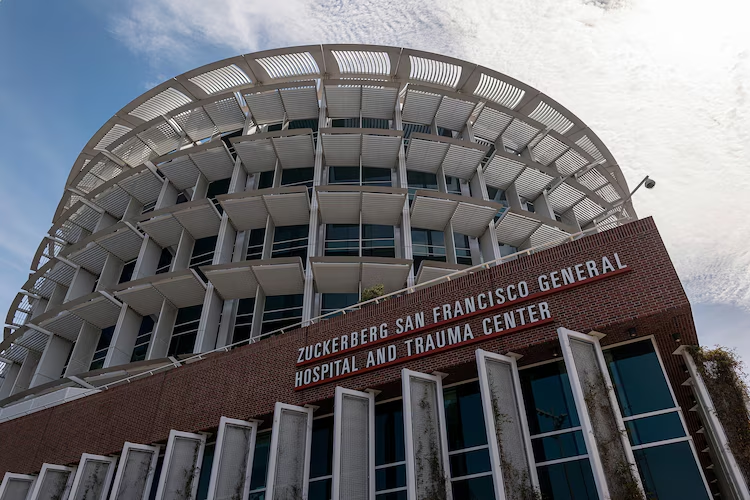
SAN FRANCISCO — A tragedy at one of California’s premier medical institutions has left a community in mourning and a workforce in revolt. Authorities confirmed late Saturday that a dedicated Social Worker Dies in San Francisco Hospital Stabbing injuries, two days after being brutally attacked inside Zuckerberg San Francisco General Hospital (ZSFG). The suspect, identified as 34-year-old Wilfredo Tortolero Arriechi, is now facing murder charges as unions and staff members demand immediate answers regarding the facility’s security protocols.
The incident, which occurred in broad daylight within the celebrated Ward 86 HIV/AIDS clinic, has exposed deep rifts between the hospital’s administration and the law enforcement officers tasked with protecting it. As colleagues remember the victim as “remarkable” and “compassionate,” the political fallout from the death is intensifying, with labor leaders pointing directly to recent staffing cuts as a contributing factor to the fatal event.
The Incident: Chaos in Ward 86
The attack unfolded at approximately 1:39 p.m. on Thursday, December 4, 2025. According to the San Francisco Sheriff’s Office, the chaos began on the hospital’s sixth floor, home to Ward 86, the oldest dedicated HIV/AIDS outpatient clinic in the United States.
Wilfredo Tortolero Arriechi had reportedly arrived at the facility for a scheduled medical appointment. However, the situation escalated rapidly when he allegedly began making threats against a doctor. Hospital staff, adhering to protocol, requested security assistance. A sheriff’s deputy responded to the call to provide protection for the physician.
It was during this security escort that the deputy heard a separate disturbance erupting in the nearby hallway. Upon investigating, the deputy discovered Arriechi in the midst of a violent assault on a social worker. According to the Sheriff’s Office, the suspect was armed with a five-inch kitchen knife—specifically described as a steak knife—and was stabbing the victim repeatedly in the neck and shoulder area.
The deputy intervened immediately, restraining Arriechi and securing the scene, but the damage had been done. The victim, initially identified as a 31-year-old woman but later clarified to be a 51-year-old University of California, San Francisco (UCSF) employee, was rushed to the operating room in critical condition. Despite the heroic efforts of her own colleagues to save her, she succumbed to her injuries on Saturday, December 6, 2025.
Social Worker Dies in San Francisco Hospital Stabbing: The Suspect
The man at the center of this tragedy, Wilfredo Tortolero Arriechi, was taken into custody at the scene. Initially arrested on charges of attempted murder, his legal peril deepened significantly following the victim’s death.
San Francisco Police have confirmed that Arriechi is now facing murder charges. In addition to the homicide charge, he faces counts of:
-
Assault with a Deadly Weapon: For the use of the kitchen knife.
-
Mayhem: A charge typically reserved for crimes that result in disfigurement or the disabling of a body part, reflecting the severity of the wounds inflicted.
-
Being Armed During the Commission of a Felony.
Arriechi was booked into the San Francisco County Jail. As of Sunday, no motive had been publicly released beyond the initial reports of his aggression toward the doctor. Investigators are currently reviewing his medical history and previous interactions with hospital staff to determine if there were warning signs that were missed. The fact that he brought a five-inch knife to a scheduled appointment suggests a degree of premeditation that prosecutors will likely leverage in court.
A “Remarkable” Life Lost
While the name of the victim has been withheld by the San Francisco Department of Public Health (DPH) due to privacy laws, the tributes pouring in paint a picture of a deeply loved professional.
The victim was a social worker employed by UCSF, which partners with ZSFG to staff the hospital. In the high-stress environment of a public safety-net hospital, social workers are often the glue that holds patient care together, navigating complex cases involving homelessness, mental health, and chronic illness.
UPTE-CWA 9119, the union representing professional and technical employees at the University of California, issued a heartbreaking statement following the news that the Social Worker Dies in San Francisco Hospital Stabbing.
“We at UPTE-CWA 9119 are devastated to learn of the death of a remarkable, compassionate, and dedicated social worker, who was beloved by their family, friends, colleagues, and fellow union members,” said Dan Russell, the union’s president.
Colleagues described her as a pillar of the Ward 86 community, someone who dedicated her life to serving the city’s most vulnerable populations. The discrepancy in her reported age—initially stated as 31 by police and later corrected to 51 by the Sheriff’s Office—caused some confusion in early reports, but the final confirmation highlights that the victim was an experienced veteran of the field.
The Security Controversy: “Response-Only” Model Under Fire
The death has triggered an immediate and furious debate regarding security staffing at Zuckerberg San Francisco General. The San Francisco Deputy Sheriff’s Association, the union representing the deputies, did not mince words in their response to the tragedy.
Ken Lomba, president of the deputy sheriff’s union, explicitly criticized the San Francisco Department of Public Health for what he termed a dangerous shift in security strategy. According to Lomba, the hospital recently moved to a “response-only” security model.
What is the “Response-Only” Model? Under a traditional security model, deputies or guards might be stationed permanently in high-risk units like the Emergency Department or psychiatric wards (Ward 86 also deals with a high volume of complex psychosocial cases). In a “response-only” model, security personnel are stationed centrally or on patrol and only deploy to a specific unit when called—similar to calling 911.
Lomba argues that this reduction in proactive presence is directly linked to the fatality. “This was not a random unforeseeable incident,” Lomba stated. He pointed to the hospital’s own data, which reportedly shows “years of serious assaults and weapons on campus.”
The union’s contention is that had a deputy been stationed on the floor rather than just responding to a specific call about a doctor, the presence of law enforcement might have deterred Arriechi from bringing a weapon, or the response to the stabbing might have been instantaneous.
Hospital Administration Responds
The San Francisco Department of Public Health (DPH), which operates the hospital, is now on the defensive. In a statement released to ABC News and other outlets on Sunday, the DPH expressed their condolences but also defended their commitment to safety.
“Keeping our staff, patients, and community safe is our highest priority,” the statement read.
In the wake of the news that a Social Worker Dies in San Francisco Hospital Stabbing, the DPH announced a series of immediate security upgrades:
-
Increased Staffing: Adding more security officers to the rotation immediately.
-
Access Control: Limiting the number of entry points to the hospital to better monitor who is coming and going.
-
Weapon Detection: Accelerating the installation of advanced weapons detection systems (likely modern scanners that are less intrusive than metal detectors but effective at spotting knives and guns).
“We are also conducting a full investigation and are committed to making both immediate and long-term safety improvements at all our facilities,” the DPH added. “This tragic event underscores the urgency of our ongoing efforts to strengthen protections for every member of our workforce.”
However, for many staff members, these measures feel like “too little, too late.” The fact that weapons detection systems are being “sped up” implies they were already in the works but not yet operational—a delay that critics say cost a woman her life.
Ward 86: A Historic Clinic in Shock
To understand the gravity of this event, one must understand the significance of the location. Ward 86 is hallowed ground in the history of medicine. Opening in 1983, it was the first dedicated HIV/AIDS clinic in the world. It was the epicenter of the San Francisco Model of Care, which emphasized compassion, social support, and medical excellence during the darkest days of the AIDS epidemic.
Social workers in Ward 86 are not just case managers; they are lifelines. They assist patients who often face intersecting challenges of poverty, substance use, and stigma. The violence occurring in such a space—a sanctuary for so many—has shaken the hospital staff to its core.
The attack disrupts the therapeutic environment essential for patient care. Patients at Ward 86 often require a sense of safety to discuss sensitive health issues. The knowledge that a Social Worker Dies in San Francisco Hospital Stabbing just down the hall creates an atmosphere of fear that could deter patients from seeking necessary treatment.
The Growing Trend of Violence in Healthcare
Sadly, the death of this social worker is not an isolated anomaly but part of a disturbing national trend. According to the Occupational Safety and Health Administration (OSHA), healthcare workers account for approximately 50% of all victims of workplace violence in the United States.
Hospitals are unique environments where high emotions, mental health crises, and open public access intersect. Emergency rooms and psychiatric units are frequent flashpoints, but as this incident proves, outpatient clinics are not immune.
The concept of “Safety Net” hospitals like ZSFG means they serve everyone, regardless of ability to pay or background. This often includes patients with untreated severe mental illness or histories of violence. Without robust security, the staff—doctors, nurses, and social workers—are left vulnerable.
UPTE-CWA 9119’s demand for “reliable, consistent, and transparent safety protocols” echoes a nationwide cry from healthcare unions. They are calling for:
-
Metal Detectors: Universal screening at all hospital entrances.
-
Panic Buttons: Wearable devices for all staff.
-
De-escalation Training: Enhanced training for handling aggressive patients.
-
Safe Staffing Ratios: Ensuring enough staff are present to handle crises.
Legal and Administrative Next Steps
As the legal case against Wilfredo Tortolero Arriechi proceeds to the San Francisco Superior Court, the administrative investigation within DPH will run parallel.
The Criminal Case: Arriechi’s defense will likely hinge on his mental state. Given the location of the attack and the nature of the outburst, a psychiatric evaluation will almost certainly be ordered. If he is found competent to stand trial, he faces life in prison. The upgrade from attempted murder to murder will delay the proceedings as new arraignments are scheduled.
The Internal Investigation: The DPH investigation will likely focus on:
-
How Arriechi entered the building with a five-inch knife.
-
Why the “threats” against the doctor did not trigger an earlier intervention or search of the suspect.
-
The response time of the deputy.
-
The effectiveness of the current “response-only” model.
The Deputy Sheriff’s Association has signaled they will not let the issue rest. They are expected to lobby the San Francisco Board of Supervisors to mandate minimum staffing levels for deputies at ZSFG, effectively overruling the DPH’s “response-only” policy.
Community Support and Mourning
In the days since the attack, makeshift memorials have begun to appear near the hospital campus. Flowers and notes are being left for the unnamed victim, a testament to the lives she touched.
“She was the person who sat with you when you got the bad news,” said a former patient of Ward 86 who wished to remain anonymous. “She didn’t just do her job; she cared. It’s impossible to think she’s gone.”
The tragedy has unified the various unions at UCSF and ZSFG. Nurses, doctors, and technical staff are wearing ribbons and organizing vigils. There is a palpable sense of anger mixed with the grief—anger that a place of healing became a crime scene.
Conclusion: A Wake-Up Call for San Francisco
The headline that a Social Worker Dies in San Francisco Hospital Stabbing is a grim marker for the end of 2025. It highlights the perilous conditions facing those who dedicate their lives to public service.
Wilfredo Tortolero Arriechi sits in a jail cell, awaiting judgment. But the judgment of the public is already turning toward the system that allowed this to happen. The debate over the “response-only” security model will likely result in policy changes, but those changes come too late for the 51-year-old woman who went to work on Thursday to help others and never came home.
As San Francisco grapples with this loss, the demand is clear: protect the protectors. The healthcare workers of ZSFG are asking for more than just thoughts and prayers; they are demanding walls, guards, and protocols that ensure they can save lives without risking their own.
Summary of Key Facts:
-
Victim: 51-year-old female Social Worker (UCSF Employee, Name withheld).
-
Suspect: Wilfredo Tortolero Arriechi (34).
-
Charges: Murder, Assault with Deadly Weapon, Mayhem.
-
Location: Zuckerberg San Francisco General Hospital, Ward 86 (HIV/AIDS Clinic).
-
Date of Attack: Thursday, Dec 4, 2025.
-
Date of Death: Saturday, Dec 6, 2025.
-
Weapon: 5-inch kitchen/steak knife.
-
Controversy: Sheriff’s Union blames “response-only” security model for the death.
Leave a Reply