
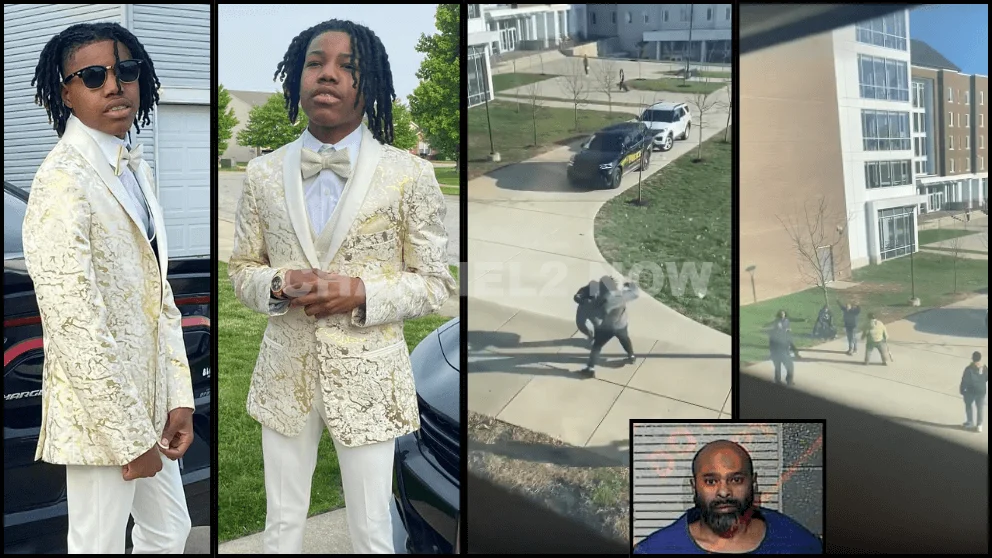
Surveillance Video Captures Moments Before Kentucky State University Student Dejon Fox Was Fatally Shot; Suspect Jacob Lee Bard Charged with Murder.
A Campus Shattered: Video Reveals Final Moments Before Kentucky State University Student Dejon Fox is Killed; Non-Student Jacob Lee Bard in Custody.
FRANKFORT, Ky. — A chilling silence has fallen over the historic campus of Kentucky State University (KSU), pierced only by the lingering echoes of trauma and the urgent questions of a grieving community.
The release of new surveillance footage has brought a visceral, heartbreaking clarity to the tragedy that unfolded on Tuesday afternoon, showing the moments before 19-year-old student Dejon Fox was shot and killed in an act of violence that has shaken the institution to its core.
The video, obtained and reviewed by investigators, depicts the suspect, 48-year-old Jacob Lee Bard of Evansville, Indiana, brandishing a firearm and pointing it toward two individuals on the university’s south campus, near Whitney M. Young Jr. Hall. Seconds later, gunfire erupted, transforming an ordinary December afternoon into a scene of chaos and tragedy. This visual evidence now forms the grim backbone of a criminal case that has mobilized local, state, and federal authorities and drawn statements from Kentucky’s highest office.
I. Timeline of Terror: Four Minutes That Locked Down a University
The official timeline provided by the Frankfort Police Department outlines a response that was both rapid and overwhelming:
· 3:10 p.m.: The first calls flood 911 dispatchers, reporting an active aggressor on the KSU campus. The term “active aggressor” triggers the highest level of emergency protocol, sending alarms across campus notification systems.
· 3:14 p.m.: Frankfort Police officers arrive on scene. Within a breathtaking four-minute window, they locate the area near Whitney M. Young Jr. Hall, secure the immediate vicinity, and detain Jacob Lee Bard. The swift containment likely prevented further bloodshed.
· The scene was secured, but the human cost was already devastating. Dejon Fox lay mortally wounded. A second, unidentified student was also struck by gunfire and remains in stable but critical condition at a local medical facility, fighting for their life.
The efficiency of the response underscores the grim reality of modern law enforcement training for such events. “The first officers on scene acted with precision and courage,” said a Frankfort PD spokesperson. “Their primary goal was to neutralize the threat, and they accomplished that. Our hearts, however, are with the victims and their families.”
II. The Victims: Dejon Fox and a Community in Mourning
While the second victim’s identity is being withheld at the family’s request, the life of Dejon Fox has begun to emerge through the grief of those who knew him. Described by friends and glimpsed through social media, Fox was a young man at the beginning of his academic journey at Kentucky’s premier public historically black university. KSU, founded in 1886, is a pillar of educational opportunity and community, making the violent death of one of its own within its bounds particularly resonant and painful.
The university’s formal statement was heavy with sorrow: “Two Kentucky State University students were shot, and we are heartbroken to report that one of the students succumbed to their injuries… Out of respect for the families, no additional identifying information will be released at this time.”
Dr. Koffi C. Akakpo, President of KSU, is expected to address the campus community directly once the immediate investigative needs are met. The university has emphasized that counseling and support services through the Office of Student Affairs are available immediately for all students, faculty, and staff. “We must lean on each other,” a university memo read. “This is a time for compassion and collective healing.”
III. The Suspect: Jacob Lee Bard and the Question of Motive
The arrest of Jacob Lee Bard has raised more questions than answers. According to law enforcement and university officials, Bard is not a KSU student. His presence on campus, and what connection—if any—he had to the victims, is a central focus of the ongoing investigation.
Bard, from Evansville, Indiana, was booked into the Franklin County Regional Jail, where he is being held without bond. He faces formal charges of murder and first-degree assault. The Frankfort Police Department, leading the investigation in coordination with the Franklin County Commonwealth’s Attorney, has not speculated on a motive publicly. Investigators are meticulously reviewing Bard’s background, digital footprint, and any potential history with the university or the victims.
The involvement of the Bureau of Alcohol, Tobacco, Firearms and Explosives (ATF) suggests a focus on the firearm used—its origin, history, and how it came into Bard’s possession. The Kentucky State Police and the Franklin County Sheriff’s Office are providing forensic and logistical support, while Kentucky Homeland Security aided in the immediate lockdown protocol and threat assessment.
IV. Leadership Responds: From the Governor’s Office to City Hall
The tragedy prompted swift responses from leaders across the commonwealth. Kentucky Governor Andy Beshear addressed the public via a statement on social media, seeking to calm fears while acknowledging the profound loss.
“Violence has no place in our commonwealth or country,” Governor Beshear wrote. “Let’s please pray for the families affected and for our KSU students. Thank you to our brave law enforcement who acted quickly to protect our people.” The governor’s office characterized the shooting as an isolated incident, assuring the public that there is no ongoing threat.
At the local level, Frankfort City Commissioner Katima Smith-Willis articulated the deep bond between the city and the university. “During difficult moments such as this, I encourage us all to lean into respect, compassion, and care for one another,” Commissioner Smith-Willis stated. “Kentucky State University is not just the university—it is our university, rooted deeply in our community.”
Her words highlight the symbiotic relationship between KSU and Frankfort. The university is not an isolated enclave but an integral economic, cultural, and social organ of the capital city. An attack on the campus is felt as an attack on the entire community.
V. The Broader Context: Campus Safety in the National Spotlight
This incident at KSU enters a national conversation that is, tragically, all too familiar. Campus shootings, from Virginia Tech to UCLA, have forced institutions of higher learning to become fortresses of preparedness. KSU, like all universities, has detailed active aggressor protocols, including text alerts, lockdown procedures, and regular safety drills.
The effectiveness of these protocols is now under a microscope. The lockdown, which remained in effect for several hours as police cleared buildings, was executed as planned. The rapid police response also aligned with best practices. However, the fundamental, unsettling question persists: How does a non-student, Jacob Lee Bard, allegedly enter campus with a firearm and carry out such an act?
This raises issues of campus perimeter security, visitor policies, and the pervasive challenge of gun violence in American society. While KSU’s campus is relatively open, typical of many public universities, this event will inevitably lead to a painful review of all safety measures.
VI. The Path Forward: Grief, Investigation, and Healing
The immediate path forward is threefold: Justice, Understanding, and Healing.
1. The Legal Process: The case against Jacob Lee Bard is in its earliest stages. The surveillance video will be a critical piece of evidence, likely to be presented to a grand jury for indictment. The Franklin County Commonwealth’s Attorney will build a case seeking the maximum accountability under Kentucky law. Meanwhile, the injured student’s recovery will be closely monitored, both for their wellbeing and for their potential testimony.
2. The Investigation: The multi-agency task force will work to construct a definitive timeline and motive. Every aspect of Bard’s life is being scrutinized. Investigators will seek to determine if he acted alone, how he traveled from Indiana to Kentucky, and what his intentions were. The answers are crucial not only for the prosecution but for providing a measure of closure to the victims’ families and the campus community.
3. Community Healing: For KSU, the healing process has already begun, but it will be long and arduous. Vigils are being planned. Counseling services will be in high demand for weeks and months to come. The university must balance the need for memorializing Dejon Fox with the practical necessity of resuming its educational mission. Faculty will need support in addressing traumatized students in their classrooms.
The identity of KSU as an HBCU (Historically Black College or University) adds another layer to the community’s grief. These institutions have long served as sanctuaries of empowerment and uplift. A violent breach of that sanctuary feels like a profound violation of a sacred space.
Conclusion: A Life Cut Short, A Campus Forever Changed
The story of December 10th at Kentucky State University is no longer just about a police response time or a security review. It is, forever, the story of Dejon Fox, a young man whose potential was violently erased. It is the story of another student fighting for life in a hospital bed. It is the story of thousands of fellow students, faculty, and staff whose sense of safety has been fundamentally altered.
The video footage, while critical for justice, also immortalizes a terrifying finale. As the investigation continues and Jacob Lee Bard awaits his day in court, the KSU community is left to pick up the pieces. They will do so, as Commissioner Smith-Willis urged, by leaning into respect, compassion, and care—holding onto the very values that a gunman, in a moment of violence, sought to destroy.
The campus remains physically open but emotionally scarred. The journey back to normalcy will be a testament to the resilience of the Thorobred spirit, but it is a journey that begins in a shadow that will never fully lift.
This is a developing story. Further updates from the Frankfort Police Department, Kentucky State University, and the Franklin County Commonwealth’s Attorney’s Office will be provided as they become available.
Leave a Reply