
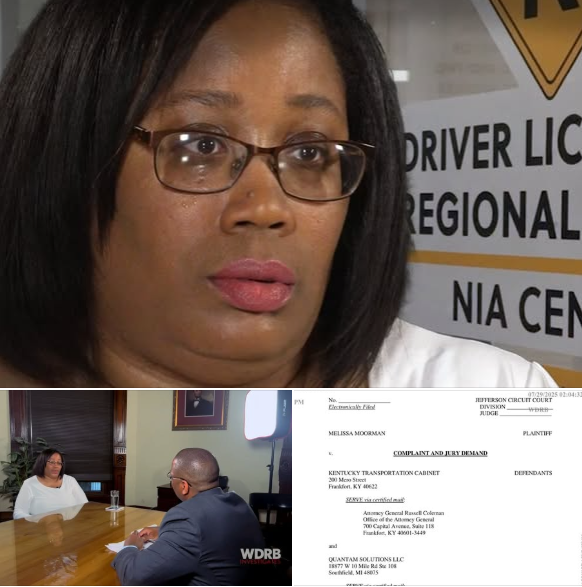
LOUISVILLE, Ky. — In a shocking allegation that strikes at the heart of public trust and national security, a former clerk at a Kentucky driver’s licensing office claims she was unceremoniously fired for doing the one thing public servants are sworn to do: reporting a crime. Melissa Moorman, a former worker at the Nia Center Licensing Branch in Louisville, has filed a lawsuit alleging that she blew the whistle on a massive, multi-year corruption scheme involving her co-workers—only to be terminated the very same day she spoke to detectives.
The lawsuit, which details a “cash-for-IDs” operation that reportedly spanned multiple offices and lasted for at least two years, paints a disturbing picture of the Kentucky Transportation Cabinet (KYTC). According to Moorman, state employees were selling valid Kentucky driver’s licenses for $200 a pop to individuals who were legally ineligible to obtain them, bypassing critical federal background checks and road safety tests. Even more chilling, Moorman alleges the corrupt clerks used her computer login credentials to process the illegal transactions, effectively framing her for the crimes she was trying to stop.
The Whistleblower: Melissa Moorman’s Story
Melissa Moorman was not a high-ranking bureaucrat or a political appointee. She was a front-line worker, employed through a staffing agency to help manage the heavy flow of citizens seeking licenses and Real IDs at the Nia Center Licensing Branch on West Broadway in Louisville.
For many, the DMV is a place of long lines and bureaucracy. But for Moorman, it became a front-row seat to organized crime. According to her complaint, she began to notice irregularities in the way certain co-workers handled specific “clients.” These weren’t standard applicants nervous about their parallel parking test. These were individuals who, Moorman alleges, were ushered through the system with a wink and a nod—and a cash payment.
The scheme, as described in legal filings, was brazen. Moorman claims that two of her co-workers were actively soliciting and accepting bribes. The going rate for a state-issued driver’s license was reportedly $200.
For that price, the applicant didn’t just get a laminated card; they purchased an exemption from the law. They skipped the mandatory written exams. They skipped the road tests designed to ensure public safety. Most critically, they bypassed the federal background checks required by the Department of Homeland Security for Real ID compliance.
Anatomy of the Scheme: “Several Times a Day”
The scale of the alleged corruption is staggering. This was not a one-time favor for a friend or a family member. Moorman alleges that the activity occurred “several times a day” and had been ongoing for “at least two years.”
If these figures are accurate, the math is terrifying. Even if only two illegal licenses were sold per day, over the course of two years (roughly 500 working days), that would equate to 1,000 fraudulent licenses issued from just one location. At $200 per bribe, the corrupt employees would have pocketed $200,000 in illicit cash.
However, the lawsuit suggests the rot went deeper than just the Nia Center. Moorman claims the activity was occurring at “multiple offices across the state,” suggesting a coordinated ring rather than a few rogue bad apples.
The “Ghost” Login: Perhaps the most insidious part of the scheme was the method used to process the paperwork. Moorman discovered that the fraudulent licenses were being entered into the state’s computer system using her unique login credentials.
This tactic served a dual purpose for the perpetrators:
-
Access: It allowed them to bypass their own transaction limits or audit trails.
-
The Fall Guy: It set up Melissa Moorman as the perfect scapegoat. If an audit ever flagged the illegal licenses, the digital trail would lead straight to Moorman, not the people taking the cash.
Realizing that her identity was being used to facilitate felonies, Moorman faced a critical choice: stay silent and risk being arrested when the scheme inevitably collapsed, or speak up and risk her job. She chose to speak up.
The Report and The Retaliation
Moorman took her concerns up the chain of command, reporting the illegal activity to state officials. She detailed the bribes, the bypassed tests, and the unauthorized use of her credentials.
The state’s response initially appeared to be appropriate. An investigation was launched. On the day in question, a detective—presumably from the Kentucky State Police or an internal investigations unit—arrived at the Nia Center to interview Moorman.
This should have been the moment the system protected its witness. Instead, it was the end of her career.
According to the lawsuit, on the very same day that Moorman sat down with the detective to provide evidence against the corrupt ring, she was fired. There was no probationary period, no administrative leave, and no protection. The staffing agency, acting on the directive of the state office, terminated her assignment immediately.
The timing was unmistakable. To Moorman and her attorney, this was not a coincidence; it was a clear message. “You talk, you walk.”
State Denials and Legal Defense
The Kentucky Transportation Cabinet (KYTC) has officially denied the allegations of retaliation. In statements regarding the lawsuit, officials have maintained that Moorman’s firing was unrelated to her whistleblowing activities.
The defense likely hinges on Moorman’s employment status. Because she worked through a third-party staffing company, she was technically a contract worker, not a merit-system state employee. Contract workers in “at-will” employment states generally have fewer protections and can be let go for almost any reason—or no reason at all.
However, employment law has carved out specific exceptions for “public policy” violations. Even at-will employees generally cannot be fired for refusing to commit a crime or for reporting illegal activity, particularly when that activity endangers public welfare. Moorman’s legal team is arguing that her termination violates the Kentucky Whistleblower Act, which is designed to protect public employees who expose waste, fraud, and abuse.
The state may argue that her performance was lacking or that the staffing contract ended naturally, but the proximity of the firing to the detective’s interview creates a “temporal proximity” that is often difficult to defend in court.
The National Security Nightmare
While the wrongful termination lawsuit focuses on Moorman’s lost wages and emotional distress, the broader implications of her allegations are a matter of national security.
A driver’s license is the primary form of identification in the United States. It is the “breeder document” used to obtain other rights and privileges.
-
Airport Security: A valid driver’s license allows an individual to pass through TSA checkpoints and board domestic flights. If terrorists or individuals on a no-fly list were able to purchase clean Kentucky IDs for $200, the security of the entire air travel network is compromised.
-
Gun Purchases: In many states, a driver’s license is the only ID required to purchase a firearm.
-
Voter Fraud: A valid state ID is the key requirement for voting in Kentucky.
-
Human Trafficking: Traffickers often use fraudulent IDs to move victims across state lines or to enroll them in services under false names.
If Moorman’s allegations are true—that federal background checks were bypassed—it means the state of Kentucky has effectively lost control of who is carrying its identification. The Department of Homeland Security (DHS) requires strict adherence to the Real ID Act. Systematic corruption of this magnitude could threaten Kentucky’s compliance status, potentially invalidating the licenses of millions of law-abiding citizens for federal use.
“No Driving Tests, No Background Checks”
The specific detail that applicants were bypassing driving tests adds a layer of immediate physical danger to the public.
-
The Unqualified Driver: A person willing to pay a $200 bribe likely cannot pass the test legitimately. This means there are potentially hundreds of drivers on Kentucky roads who do not know the traffic laws or lack the physical skill to drive safely.
-
The Revoked License: The scheme would be particularly attractive to individuals who have had their licenses revoked for DUI (Drunk Driving) or reckless homicide. By paying the bribe, these dangerous drivers could be back behind the wheel with a “clean” license, putting every other family on the road at risk.
The Lawsuit: Seeking Justice and Damages
Melissa Moorman’s lawsuit seeks compensatory damages for lost wages, benefits, and emotional distress. But perhaps more importantly, it seeks vindication.
The suit alleges Wrongful Termination in Violation of Public Policy. It argues that the state’s actions have a chilling effect on other potential whistleblowers. If a clerk sees corruption tomorrow, will they report it? Or will they look at Melissa Moorman—fired and forced to hire a lawyer—and decide to keep their head down?
“The message sent by the Transportation Cabinet is clear,” said a legal analyst reviewing the case. “Loyalty to the ‘club’ is more important than loyalty to the law. If they can fire a witness hours after talking to the police, they are protecting the corruption, not the public.”
Broader Corruption Probes?
The lawsuit raises the question: Where are the arrests? If Moorman gave a detective names, dates, and evidence of a two-year criminal enterprise, the public expects to see the perpetrators in handcuffs.
-
Are the two co-workers still employed?
-
Have they been placed on administrative leave?
-
Are federal authorities, such as the FBI or DHS, involved given the Real ID violations?
The silence from law enforcement regarding the criminal side of the investigation is deafening. While the civil suit plays out, the criminal investigation into the “cash-for-licenses” ring should be a top priority for the Attorney General.
The allegation that this occurred at “multiple offices” suggests a network. Was there a manager coordinating the bribes? How was the money split? Did the staffing agency know? These are questions that investigators must answer to restore faith in the system.
The Human Cost
For Melissa Moorman, the cost has been personal. Being fired is traumatic; being fired for integrity is devastating. “I was doing my job,” Moorman reportedly told friends. “I didn’t want my name used to commit crimes. I didn’t want dangerous people on the road. And for that, I lost my livelihood.”
She now faces the daunting prospect of a legal battle against the state government, an entity with vastly more resources than a single former contract worker.
Conclusion: A System on Trial
The case of Melissa Moorman vs. The Commonwealth is about more than one job. It is a stress test for the integrity of Kentucky’s government.
If the allegations are proven true, the Nia Center Licensing Branch was operating as a criminal enterprise under the guise of a government office. The sale of driver’s licenses undermines the rule of law and endangers the lives of everyone—from the drivers on the highway to the passengers on an airplane.
The firing of the whistleblower suggests a frantic attempt to cover up the rot rather than excise it. As the lawsuit moves through the courts, the public will be watching to see if the state of Kentucky defends the indefensible, or if justice will finally be served for the woman who refused to sell out her community for $200.
Call to Action: This is an ongoing story. If you suspect fraud at a DMV or licensing office, or if you have information regarding the Nia Center investigation, you are urged to contact the Kentucky Attorney General’s Office or the FBI Public Corruption Tipline.
Summary of Key Facts:
-
Plaintiff: Melissa Moorman (Former Clerk).
-
Location: Nia Center Licensing Branch, Louisville, KY.
-
The Alleged Crime: Co-workers selling licenses for $200; bypassing federal checks.
-
Duration: 2+ years; multiple offices.
-
The Retaliation: Moorman fired the same day she was interviewed by a detective.
-
State Response: Denies retaliation; claims firing was unrelated.
-
Legal Status: Civil lawsuit filed; criminal investigation status unknown.
Leave a Reply